
I haven’t posted plant photos when writing about the last two stops. One reason is that there’s been enough to show. The second reason is, there weren’t that many plants.
Plants growing in harsh habitats are always interesting though. The growing season in the tundra is short, although for a while the days do have hours and hours of light. There is ample moisture during the growing season, but there is also a lot of wind. What we saw showed adaptation to these conditions.
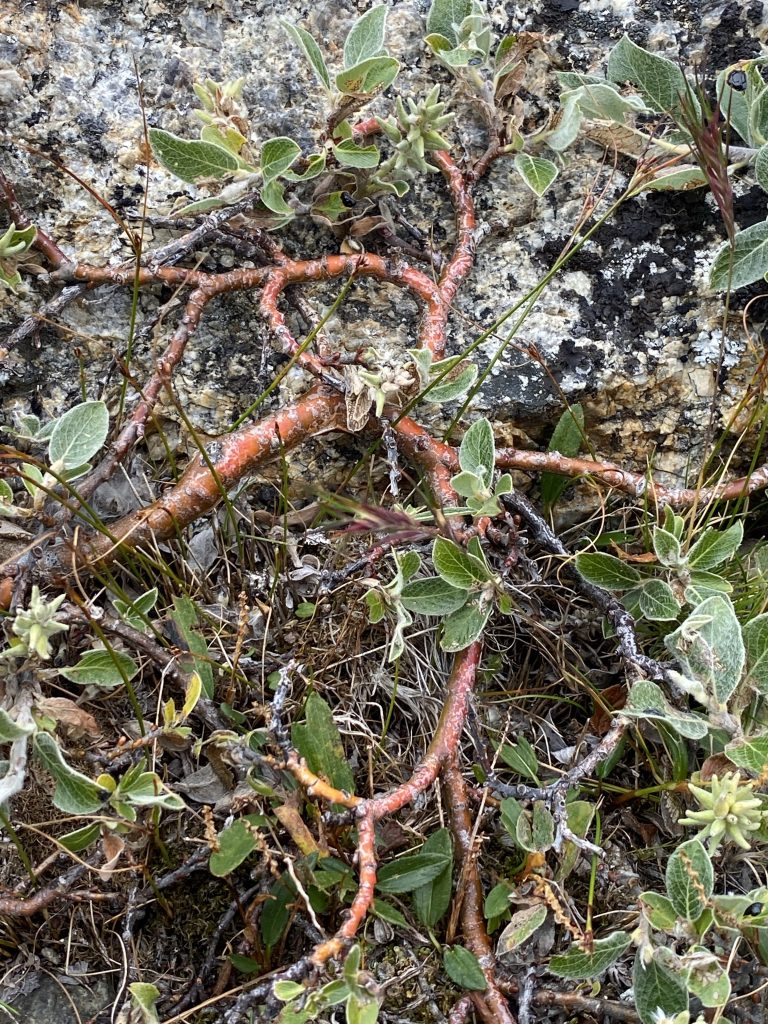
In Aappilattoq, it was hand & knees botany all the way. Here is willow:

The particular individual, sprawled out on the rock, lets everyone see that it’s a woody plant. It is easily decades old. Rooted in a small crack, it gets water from run off from the bedrock and mineral breakdown would likely happen at a good pace for growth, as long as the sediment doesn’t wash away too quickly.
But the wind! The adaptation for this is the splaying over the rock. Low to the ground as possible so the roots hold fast in the little room they have. This also allows the greatest amount of leaf area to be exposed to sunlight for photosynthesis.

Woody plants can grow even lower and flatter than the willow. The Alpine Azalea, Kalmia procumbens, was growing absolutely prone on the rocks. At this point in the season it had finished flowering and was in fruit— with red berries that actually looked a little like they were drying on the plant. It has thick, leathery leaves, like a lot of alpine plants, which is an adaptation for retaining water in a windy, desiccating environment. When it is in flower, the flowers are also sturdy, and bell shaped like blueberry flowers (a related species) are.

All the alpine adaptations are on display again in this awesome plant, the crowberry (Empetrum nigrum). Leathery leaves, low growing, and woody, crowberry is edible. There are only a couple of berries left on this individual, near the top center of the photo. It is also a relative of blueberries and huckleberries. One of our favorite items to pick up at the duty free in Reykjavik is a crowberry liqueur produced by 64º Reykjavik Distilling.

The last two plants from Aappilattoq have lovely flowers, and, I’ve never seen them flowering at the same time in the US. The first, harebell (Campanula rotundifolia), has an intense violet color. This one has a fly on it, although I know it as a bee pollinated plant, and there are two polar bumblebee species in Greenland. This plant was a little bit taller than the first three, but not much. My iPhone was right on the ground to get the photo.
In the US Rockies, harebell would typically be seen in the early part of the season— June and maybe early July at higher elevations. Here is was, blooming in August!

A late flowering plant, at least in the US, is fireweed (Epilobium), but it was in bloom in Aappilattoq at the same time as the harebell. Once again, a really vibrant color that would attractive to bees. This individual, like the harebell, above, had a fly on it. The flower was probably a warm place to perch and somewhat protected. The day we landed, unless the breeze blew, those flies perched on every living thing, especially us.


Two more, not as nicely photographed (sorry!). On the left, Yellow Rattle (Rhinanthus minor). Its European common name refers to its flower color and to the rattle that the seeds inside the dry fruits make. The pretty Mouse-Ears (Cerastium revelii), on the right, under a harebell, is in the carnation family. This family is also called the “pink” family and the cleaved petals are the giveaway (like they were trimmed with pinking shears.)


Final two plants from Aappilattoq: The Sea Mayweed (Matricaria maritima), has a pretty daisy-like flower. And the patron plant of this trip, Angelica, completely in fruit this far north, hanging tough and sturdy, by the cove.
Ivittuut (the mining ghost town) had a botanical story too. In every way, it was a highly disturbed area. Occupied by Vikings and then miners, the US military during war time, and then even more miners, many homesick people had a chance to alter the plant picture.
We did see native plants like in Aappilattoq. A new one was this Vetch:

Tufted Vetch is native to these alpine regions. In town, this plant was flowering in gulleys and very much around the backs of buildings. At first we thought it might have been escaped from cultivation. Mark’s come around to believing it is the native species, though we’d have to move away from the disturbance of the town and compare it to wild ones to know for sure. The buildings and gullys did seem to be providing it with some shelter.

The Arctic Poppy, above, was blowing in the wind and facing the ground, but with a little assistance from gloved fingers, I could capture its face.

In the photo above, the tree in the middle is a pine. Greenland has no native pines, so this was planted by miners, the homesick, the military? We don’t know. (Willow in the foreground— much taller than the one in Aappilattoq.) Many passengers asked Mark about this tree, showing that it looked out of place even without prior knowledge.

We saw several Rowan trees (above, also called Mountain ash)— always beside or behind a building. It is not native, but is a well loved tree that would make a remote and disturbed location feel like home.


5 Responses
Fantastic report. Love that vetch!
I’m loving reading this! I’d love to chat in person with you and Mark and hear about your trip sometime when we are upstate if you are interested!
Sounds like a good idea! Maybe we can connect a VC Families Weekend later this month.
We will be in Saratoga springs at a vball game 9/23 & at Vassar 10/21 I think…. Let’s see if something can work! 610 639 8676, dorothycallahan569@gmail.com
The homesick tree – is such a sentimental term and makes perfect sense for the comfort it could provide.