

Before leaving the Rotorua area, we visited the National Kiwi Hatchery. This non-profit is working hard, and smart, to give the national bird a fighting chance against mammalian predators. Kiwis are nocturnal, solitary, territorial animals. They not only fill the niche of mammals, they actually have some characteristics that are mammal-like: fur like feathers, whiskers like cats, and even a “belly button.” But they really are birds, and when still in the egg or recently hatched, they don’t have a chance against rats, possums and stoats. Ninety percent of kiwi don’t make it past six months, but if the eggs are hatched in captivity and the birds achieve a critical weight before being released, the odds of survival increase enormously. The birds can live for several decades and they breed every year, so giving them a secure start will really pay off in increasing numbers.
I have no pictures from the hatchery visit, because none are permitted. If a flash goes off it can damage the eyes of a chick. It was a great visit though, and I recommend it and hope their strong work continues. It would be devastating if New Zealand lost its iconic bird.
We flew from Rotorua, on the north island, to Christchurch on the south. The climate feels very different from the Rotorua area. It gets colder as we move south. To really hammer this point, our first stop was the Antarctic Center. Christchurch is the point of embarkation for many (perhaps nearly all?)scientific expeditions to Antarctica. At the center, our docent told us about her two visits to Antarctica, and she endorses these as being life changing. Antarctica is the only continent that by international agreement does not belong to any nation. The Antarctic Treaty was signed in 1959 by twelve nations and established the vast area as one for “peaceful purposes,” and scientific observations and cooperation, such that results will be shared. Being at the Center gave me an appreciation for the depth and breadth of research happening there, and I felt moved by New Zealand’s connection to Antarctica.
We saw a 4-D experiential film– with 3-D glasses for the movie, moving chairs, cold blasts of air, and some squirts of water as part of the experience. It was fun. I’ve heard personal stories from two or three people about science expeditions to Antarctica, and it is always interesting to learn about the studies that happen there and the tricky ways to manage living there. Mark and I were especially thoughtful when we stepped from the coach and saw a building with “United States Antarctic Program – Where Discoveries Begin – National Science Foundation” on it. This would have filled me with pride in the recent past; now it makes me worried that my country won’t be able to sustain its usual contributions to worldwide knowledge of this fragile part of the planet.
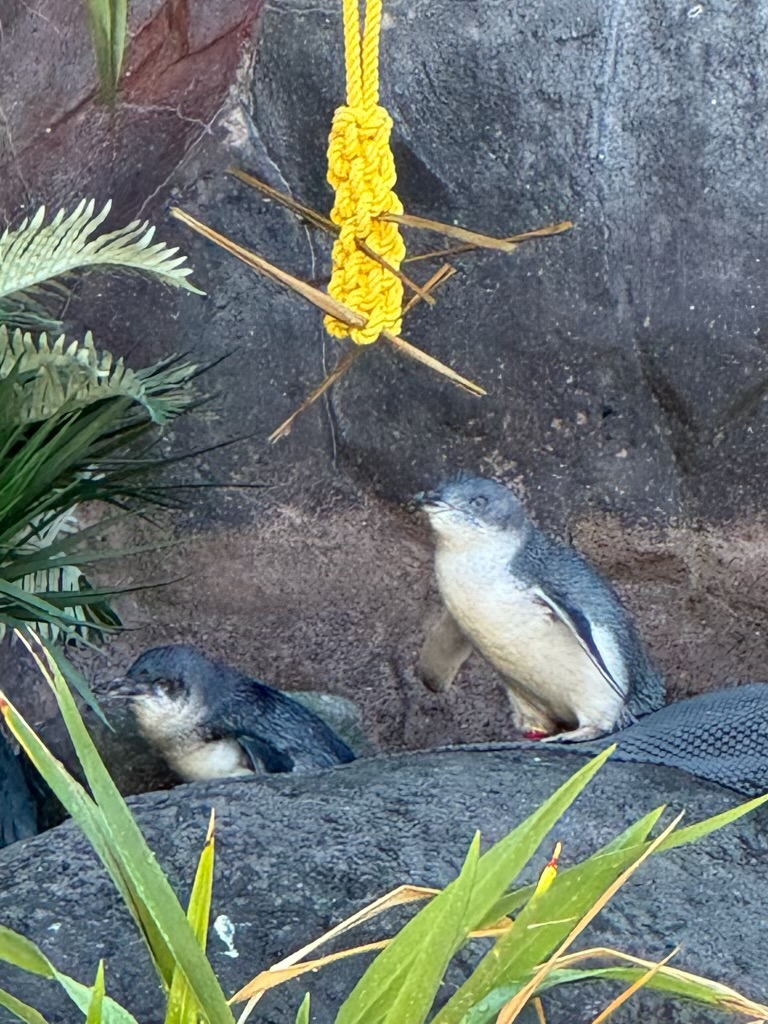
The center is home to some of little blue penguins. These used to be called fairy penguins. They are only found in New Zealand and Australia. All the penguins at the center are in captivity due to an accident of some type that would prevent them from surviving in the wild.


Another experience is the storm chamber where we donned coats, went into a large and decorated freezer, and had 25mph wind blown at us.

From the Center we drove towards the city. Culturally, Christchurch feels very different from the north island, especially the areas away from Auckland and Wellington. Christchurch seems focused on both its history as a city of immigrants from England and other parts of Europe, and its location as a university city. Māori culture is not as prevalent, and we even saw some road signs that were only in English (bear in mind that Māori and sign language are official languages).To understand the European city founders, we visited Riccarton house and bush. We had a short and pleasant guided walk through Riccarton bush, which is operated like a city park. Predators are excluded through a double door system, a fence system, trapping and even some shooting (of pigeons.)


We spent several hours at Riccarton House. This property is now in a trust and run as an historical site, but it belonged to the Deans family, whose two brothers set the site of Christchurch. Through a series of unfortunate events, the sole heir ended up being a child named John. His mother, Jane, who’d only been in New Zealand for a few months when her new husband died, had to figure out how to run the farmland until John came of age. She succeeded, and her descendents are still prominent in the Canterbury district and serve on the board of the historic site. From a beginning in a cabin, the family ended up in a very beautiful Victorian house. We had a tour and a dinner there.


So, yesterday we were eating a buffet with Māori inspired food, and the next night, we may as well have been in Britain for all the surroundings would tell us.
After dinner we had a very wonderful solo performance by a woman who told the story of her European ancestors who arrived in Christchurch in the mid 1800s. One story was of a working class English woman with a huge number of children, and the second was a Polish immigrant. The actress did a masterful job, talking non stop in the two accents for over an hour. It was riveting.

I am a bit disoriented by the “missing” Māori. This city is the least acknowledging of the role of Māoris in New Zealand as any other place I’ve been so far in the country.
By far the most exciting part of the day, though, was being handed a package when we checked in after our evening. My phone and I have been reunited, all thanks to Megan who found it and sent it to me. I can hardly believe it is still working. There were two little pebbles and one little shell still stuck in the case. I will be able to finish this trip with my own camera! This is one of the most heartwarming travel stories I’ve experienced. The kindness of Megan and a few other New Zealanders will never be forgotten.



Leave a Reply