


Every day in Italy, it crosses my mind that if I could just have a conversation with someone in the past, I would want to know… “Multiple time each day” is a better description, actually, of my questioning mind. Today my question would be put to Giovanni Martine da Udine: “Were the plants your idea? What did you think of them? How did they taste to you? and “Really, the tomato wasn’t here yet?”

All of these questions because of an elaborate detail painted on the ceiling of this villa, now called Villa Farnesina, in Trastevere. The villa was built as an open air loggia, and not the main palace, of a wealthy man named Agostini Chigi, in celebration of his wedding.The ceiling is most famous for Raphael’s beautiful, lush, and lusty painting of Cupid and Psyche.
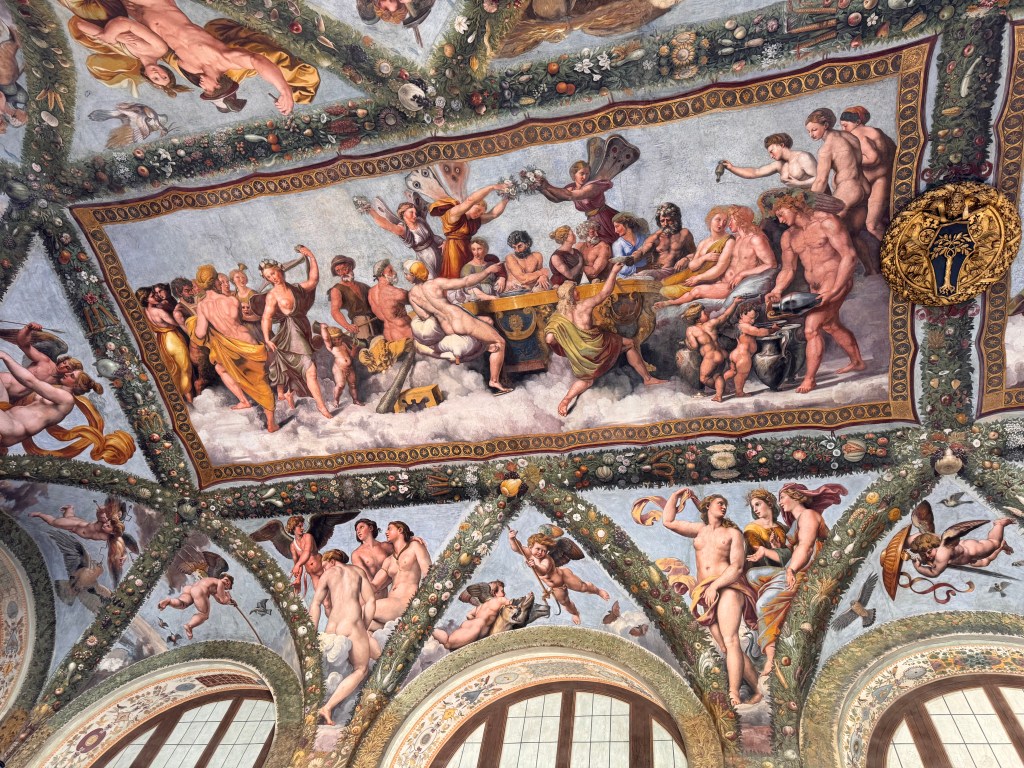
What really fascinated us though, were the garlands, or festoons that frame the figures. They depict lots of food plants (and a few animals, but they are not the stars.) All of the plants are familiar to a 21st century visitor as they would have been for any visitor up to more than 600 years ago. But in the early 1500s, when the villa was built, some would have been unfamiliar: corn, and squashes– pumpkin, and summer squashes, definitely one, a zucchini! They may not have looked like real vegetables at all to those early viewers.

Look at how beautiful the festoon is! With the plump cherubs looking so sweet and the colorful and ripe fruit, surrounding every depiction in the fresco, this must have been some start to a marriage! Consider that Columbus returned from his history changing voyage in 1493…so some of the plants in the ceiling painting, rendered between 1515 and 1517, had only been known to Europeans for 25 years, at best. They were not common. The depictions in the paintings are thought to be the first time any of these plants appeared in European art!
The museum had a special exhibit explaining the pigments used by the painter to get the colors for each plant– that was an adventure in itself. But I remain curious about what the painter thought about each new vegetable he painted. Did he have a chance to eat them? Sometimes exotic foods that we are not raised on, don’t taste great to us. Or perhaps he was fascinated? He definitely seemed to like the orange pumpkin– those, especially, popped out when I craned my neck up. Or, I have to allow, perhaps my New World eye is just drawn to like the image of a pumpkin, especially in October? Maybe they did not pop the same way in 1517?
As for the tomato…really, does any cuisine in the world understand and know how to cook with the tomato better than Italy? No, I don’t think so. And yet, the tomato is not in the festoon, and was not in Italy at all, at this time. The tomato was probably brought to Europe by Cortés, in 1519 or 1524, and did not arrive in Italy until the 1540s. So, no, Udine would not have known about them, and their glorious red color, symbol of perfect ripeness and stainer of tablecloths, had no chance to be a part of the festoon.
Finally, consider the zucchini. In American English, we adopted the Italian plural name for this squash, unlike the French and British who call it courgette. Thank goodness! I’ll take as much Italian with my English as I can, thank you very much It means “little squashes” and the breeding was completed in Milan, to be harvested and eaten as an immature gourd. Any gardener who doesn’t keep up with the prolific zucchini plants would know that they do toughen a bit, and the seeds get much larger, if not picked when a small size.
It really was a delightful midday in the museum!
Eventually, within the same century, the villa passed to the powerful and papal family, the Farnese– hence the name today Villa Farensina. There is quite a bit more history, which I did not master with all the vegetable excitement, leading to it’s status as a museum today.
We strolled back toward the hotel acquiring a gelato on the way, and took a break, and time for some blogging for me.
We connected with four fellow group members and had a nice walk over the Tiber to Campo Fiori for a typical Roman dinner at an outside table. My meal was chicken cacciatorre, a nice, simple preparation to follow the richness of our dinner at Glass last night.

On the way to our table, an American women with new Italian citizenship wanted to chat with me. She told me her years of work to get her citizenship, and the happiness was evident in her every expression.


Leave a Reply