

With cloudy skies but no actual rain, today held a beautiful walk and hike of about 9 miles or so. Each leg of the walk landed us in medieval tiny medieval towns.
We were dropped off in Gualdo Cattaneo, named after the “German” count who had the land and changed his name to make it sound Italian because it was fancier. This was quite a long time ago, before Germany was unified, so I am certainly missing some history here.

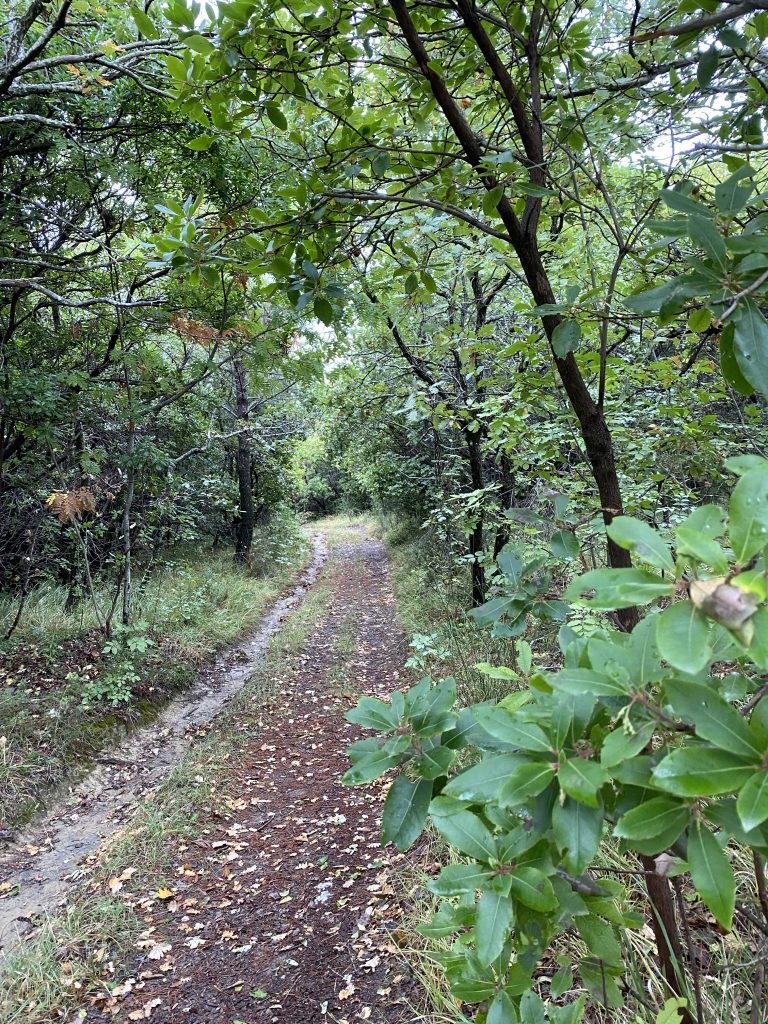
We walked up a hill on a trail and were sometimes in oak forest but more often had views of Valle Umbra, and many, many olive trees.
There are some familiar trees— today many were oak, a white oak with smaller leaves than in the Northeast of North America. I now understand why in some paintings the oak leaves have looked too small to me. There are two kinds; one with a smooth cap and one with a bur- like cap.


Umbria was one of the first places in Italy to have human inhabitants. Those early people were the Umbri, and not much is known about them except that they originated in Asia.
They were supplanted by the Etruscans who had a thriving culture of trade, agriculture and art, until they were supplanted by the Romans. The victors tell the history, so a lot of Etruscan culture is also lost.

The morning hike ended at Torre del Colle. This is a tiny hill hamlet. When you walk through it, you are surrounded by medieval stone— under your feet and on each side where the walls are built. It’s like being inside when outside. Our guide thought maybe 15 people live in the small town. If I had to pick a favorite moment from a wonderful day, it would be walking through this tiny town and being surrounded by all the stonework.


We were bused to our lunch spot, an active olive mill, Nunzi. The harvest is coming in and each arrival of fruits must be processed in 24-48 hours. Time and air, as any cook knows, is poison to good quality olive oil. The fruits are washed and the leaves removed. The oil is expelled inside a big machine at a cold temperature. Heat, as any cook knows, is poison to good olive oil. This is why excellent bottles of oil are labeled “cold pressed.” The raw oil is centrifuged to remove any unwanted solids and then decanted through stainless steel vats.


The aroma inside the expelling room is fruity and a little bit raw. The mill had examples of the old methods of pressing on display. Stones turned by donkeys were a first method, and would not have protected the oil from time, heat or air. Vertical presses were used in more modern times, but these are also not as protective. The layers that the olives were set between were first made of cloth which was hard to keep clean and microbe free. Later, mills used plastic mesh, which somehow doesn’t feel right, even though I am sure I’ve consumed oil that was pressed between plastic at many points in my life.
In Umbria, you can have backyard olive trees, harvest the fruits, and take them to the mill. Ninety minutes later, they will hand you a bottle of your own oil. Even if people don’t have their own tree, they will buy oil from a mill where they have some sort of relationship.

The mill does not have a restaurant, but there was a catered meal, featuring the oil set, up for us. The antipasti was my favorite course: tomatoes, hummus, and plain bread spread with olive oil. We had local wine, from Montefalco, a Sangrantino, poured from earthen jugs. We were served lentils for the next course, and a selection of charcuterie and cheese for the secondi. With a little cake, we also had a vin santo (sweet wine). It was a nice, slow paced meal. I’m not a day drinker and was worried I’d be too sleepy for the afternoon walking, but actually, it can work, with little sips and a nice slow meal.

Our afternoon walk was easy, about two miles, and very gradually downhill with lots of views and good conversations. Our afternoon destination was Bevagna, another small medieval town.


Bevagna had been very important for trade and was wealthy in the Roman times. It was distinctive because it sits on the floor of the valley and not on a hillside. It’s old name was Mevania, and meant “the town that stayed in the middle.” The Romans built a famous road, the flaminga that went through the town, and the city even had an amphitheater that could seat 10,000. Eventually, the main road was moved to Spello and Bevagna shrank. While there are some Roman elements remaining (we didn’t see them), much of the Roman stone was used to build the medieval walls, and those date to the first few centuries AD. Bevagna apparently has four saints— one for each of the city’s quarters. Hopefully their feasts days are scheduled with a nice distribution for this town’s fun and tourism. The main square is named for San Silvestro and his church is very old and simple. The really fascinating part is that the architects of this church put their names on the wall.

Across the plaza is San Michele Arcangelo church. It has a beautiful door and the mosaics in the arch above were a motif that originated in Tuscany and were copied all over Italy.

The town has a present too! These are active churches. And the shops on the streets were very enticing, although we had no time to visit them:


We quickly enjoyed an art exhibit where everything is made of paper. Bevagna still has a paper mill where the paper is made like in medieval times. Here are two pieces I particularly liked; mythological figures, I believe, although they were not marked:


We were driven back to Foligno for dinner and sleep before tomorrow’s morning hike. Could not fit gelato into the program today, sadly.
Some trees, familiar and not so:


And this little guy was at the olive mill and quite affectionate with anyone who wanted to give him a scratch or belly rub:



One Response
You remind me how incredible it is to walk on streets and between stone walls that were built anciently.