Ages and ages ago, the Romans held a woods near Spoleto sacred to Jupiter. It was so important to them that no tree be cut down, that the law was carved into stone. Called the Lex Spoletina, it sits in a museum, but the forest is still standing, with a replica of the stone.
Bosco Sacro is a forest of live oak, called holm oak. We walked along the San Francisco Way for a piece this morning, through these oak trees. When I was learning about this area before the trip, I pictured massive oak trunks, the kind it would take a whole Road Scholar group to circle.
The reality is quite different:


While still beautiful, the trees are not commanding in height or girth. Nevertheless, each tree is truly centuries old. This type of oak grows multiple trunks from each root. The roots have been tested for age and are over 2000 years old. None of the trunks are, though. As trunks age and die, the foresters can prune them off to prevent infection. Younger trunks sprout from the roots, over and over again. Notice that there is no understory in the forest. This is normal in a climax community, but rarely observed in nature, because there are so many ways to disturb a community.

Further along the trail, another part of the forest has black pine. These are not native to Italy but were imported from Northern Europe after war ruined the deciduous old growth forest. The species cannot reproduce in Italy. We saw plenty of cones, but perhaps it never gets cold enough to trigger germination. In any case, the undergrowth is of the expected tree community— beech, oak and hornbeam. Over time, the forest should restore to its expected trees.

Our hike ended at a farm that has been in same family since the 1700s. While they produce beef and dairy on their lands, the main attraction for their agrotourism business is truffles!

We embarked on a short walk with the main interest being the truffle hunter man and his two dogs. One dog was old and one just learned this season, Margot and Fanny.

A good piece of photography advice is “Never take a photo of an animal if you can’t capture its eyes.” Tricky rule to follow today, because these dogs seldom lifted their heads. They were nose to the ground to look for truffles and get a treat in return. Dogs can return to the same trees again and again since truffles might emerge overnight where there were none before.


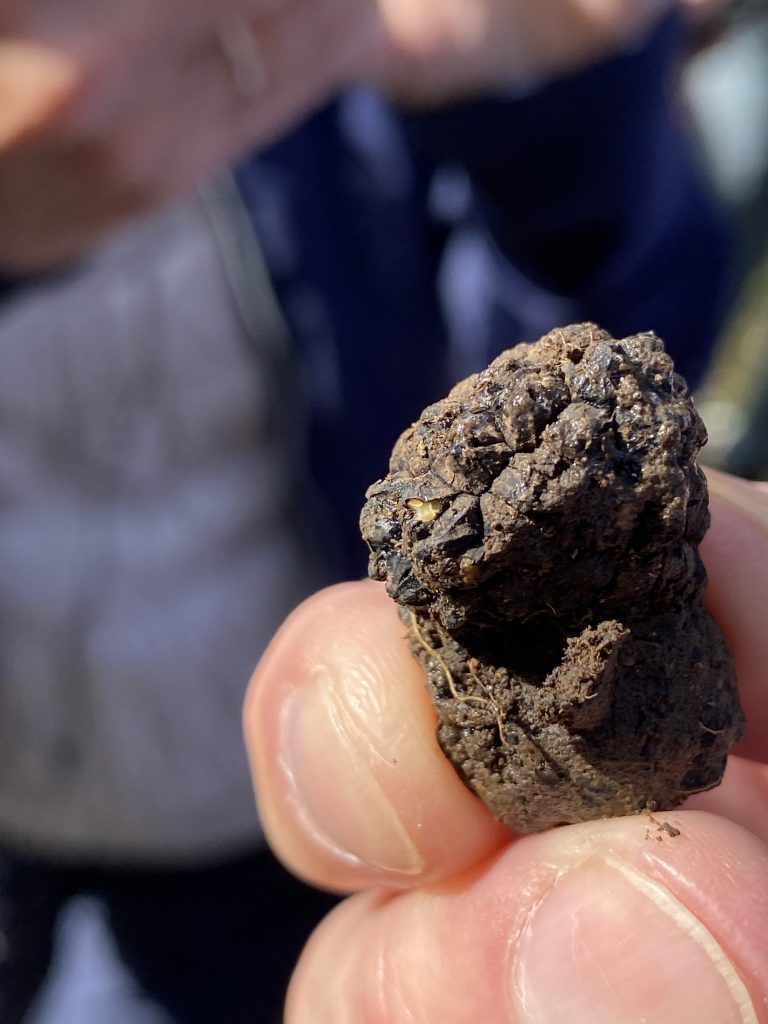
The older dog found the truffle pictured. It is actually pretty small and would not be sent to a market. The truffle hunter might even leave it in a tree so that the spores could be distributed but not distract the dogs again.

The farm made us a lavish lunch, and the pasta featured truffles.


We loaded the vans for a drive down the mountain to Spoleto. I closed my eyes all the way down. It was a narrow road with lots of turns. Those precious and delicious truffle shavings from lunch were not leaving my stomach.

Spoleto is a gothic version of the Italian medieval town, once under control of Lombardy (Germany, but before there was a unified Germany.) It is known for an impressive bridge that was part of the aqueduct.

Spoleto is home of a cathedral (The Assumption of Mary), and inside are frescos by Pinturrichio (but dark and not in good repair as in Assisi).
The two more famous works are a crucifix that predates St. Francis, and is the first signed painting, ever. This is significant because it moved painting from tradesman work to art. Notice that the crucifix depicts Jesus as peaceful and already dead and heavenly on the cross.

It was not until St Francis received the stigmata that crucifixes began to concentrate on a dying and suffering Jesus.
Behind the altar are frescos by Lippi, who was a monk with a racy and interesting life (that included fathering a son with a nun.)
His frescos here are known for their sense of perspective, for setting some scenes of Mary’s life in Spoleto, and for his impatience with the fresco technique: he tried to paint on the plaster in some scenes after they were dry. It doesn’t work.


After the walking tour of Spoleto, we were driven back to the hotel to pack and prepare for our farewell dinner. I’ll post photos of some of the dishes tomorrow. It was a first rate meal.

This Road Scholar group has said its goodbyes and we get ready for part II!
Plant of the day: Red juniper berries. We could flavor Way of St Francis gin, but wouldn’t want to sacrifice a bull.