


Our first site today was this immense Emperor Constantinople, who, though born pagan, decided that he and the empire would be most successful if everyone became Christian. Literally, the rest is history. Prada (yes, the fashion company) supported a reproduction of the original using digital scans of found fragments.
The colossus is on Capitoline Hill, one of Rome’s seven hills, where the Roman forum is. Today’s study theme was to grasp layers, in space and time. Ancient Rome lies deep beneath today’s Rome. We can see some artifacts that have been brought to the surface and reconstructed. Equally awe inspiring was much of today’s visits: we went below ground to see two areas that have been excavated, preserved, and interpreted for visitors.


First, we took in a view of the Forum. It provokes quite a lot of thought. It was a seat of an active government of the Empire of Rome for around one thousand years. Even when I was a teenager, that length of time was impressive to me. Now, it is even more so. The United States named its Capitol after Capitoline HIll and used architecture that echos that of antiquity. But we are just beginners compared to Ancient Rome’s length of rule.
And even Ancient Rome ended. I am not an expert about this at all, and my explanation for the fall of Rome is poor administration. Just as the triumphs and successes of Rome are impressive, so is the massive decline and decay of what was left behind. I suspect it was an awful time to be alive. There was no reliable administration, and illness and superstition began to take hold. Without a government to trust, people who once had systems to be proud of, must have grown very cynical, as they tried to figure out how to take care of all their needs by themsleves.
Left behind buildings were reclaimed in pieces if possible, pretty much by anyone who wanted the parts. What remained gradually caved in and became covered with earth and debris.
Near the start of the 1800s, people began to take find the ancient remains, and take an interest. It’s been explored ever since. Now, any society or individual can listen to the stories, see the ruins or photos and take meaning as they wish.


We tour the Forum later. Today, after seeing it from above, we went underground to see a Roman domus. A vast home built by a wealthy patrician, it has been excavated and visitors can walk over glass floors to see below. What is really remarkable though, is that with timed lighting and narration, the ruins below are “restored” to the viewer. So, a fragment of a mosaic is filled in with a projection. It truly helps to be able to picture what the home must have looked like.
No photography is permitted, so I only have the two signs, above. I’d recommend this stop to anyone who likes to learn about Ancient Rome. The opulence was staggering. A lot of this came from the space and energy given to water and bathing. The home had a gymnasium and then water choices at all temperatures except ice, for bathing and recovering: sauna, hot bath, tepid bath and cold bath. Different rooms with different temperatures of water. Enslaved people stoked fires to heat the water so steam could rise through vented bricks.
So much has changed and so much has stayed the same! People could excavate in many places in the USA at some future date, and find dedication to water play too!


San Clemente Church was our second underground exploration. The current church dates from the 12th century and is build on a site of fifth century church. The fifth century church site can trace its history back to building destroyed by Nero’s fire in 64CE. When the fifth century church was filled in to make a foundation for the 12th century church, frescos and chambers were preserved. They have been excavated and we walked down, down down to see them.
I thought the existence of a Mithraic chamber and school (middle and left photo) was extremely interesting. The cult overlapped with the start of Christianity. It was based on an Indo-Iranian god of light, and popular among Roman soldiers. It was secretive, but apparently involved ritual, sacramental banquets of bread, wine and meat. Interesting, no? It certainly echos, and gives some idea of what cultural components were in place at the start of Christianity. Eventually Mithraism was banned by Emperor Theodosius in the 4th century.
The “new” St. Clement church, which rose above the old, has beautiful mosaics. It is an active church; there was a mass when we first entered (right photo, above).


Rome’s Tomb of the Unknown Soldier is incorporated in the immense monument, partially pictured above, to commemorate Vittorio Emmanuel II, the first king of unified Italy. It is considered the national monument of Italy and was begun in 1885, though not considered complete until 1935. (Vittorio Emmanuel II died in 1878.) We only looked from the outside, but maybe on another visit to Rome we’ll take a tour. The space around it was not very moving today.
One more church we visited today was Santa Maria in Aracoeli (Mary of the Altar of Heaven).

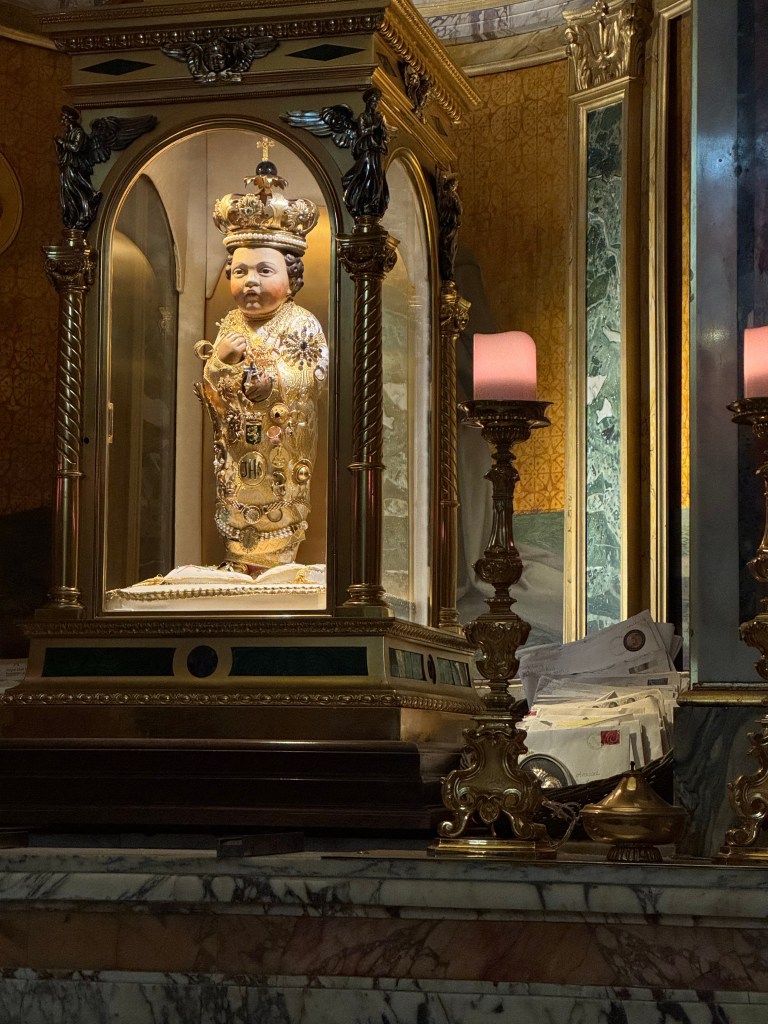

I am going to list a flight of ideas rather than a narrative due to the late hour:
This church was an ancient Roman site of a temple to Juno, so it’s always been related to the female.
As an early Christian church, it was very much a people’s church. People still write letters asking for intercession. They are piled next to the baby, in the middle photo. Eventually they are burned. Next time a burning happens, it will include my note, left on a small paper, which is provided to visitors. The smoke, when it is burned, should, if the Catholics are right, head to heaven and be interpreted by the proper administration. I’ll not share my request, but just say, I wrote as a mother.
I think the cherubic adult face on the tomb just outside of the chapel with the baby, actually looks a lot like the baby’s face.
The original baby, carved from wood from the Garden of Gethsemane, was stolen in 1994! This is a reproduction. How horrible is that, to steal a statue of a baby!


Leave a Reply