


I arranged a tour for us with Context Travel, to be delivered to the Appian Way and tour one of the catacombs. We had a guide, Philip, just for the two of us. It was a helpful and convenient way to visit this site, because the Appian Way is outside the city wall, and today was the Rome marathon. That meant our driver was late and it was hard to navigate the streets– for him. For us, it was just a little exciting to be driving out of the city and seeing this:

From 450 BCE, it was the law that bodies could not be buried or cremated inside the city walls. The grave industry moved outside the city, and the Appian Way, the long, straight road built to move the Roman army, became a sight for burials and cremations.
Early Christians, as a sect of Judaism, would have needed to be buried, not cremated (the remains needed to remain for resurrection at a later time.) The catacombs were a place where many bodies could be placed. The soils and stone were soft in this area, and gave diggers, acting as much like miners, made extensive tunnels with niches for bodies on either side.

The catacomb we visited was underneath the Church of St. Sebastian, and that part of the tour was provided by the church. Photos aren’t permitted. Although the remains have been removed, the niches where the bodies were are still prominent. They look small: people were smaller, and I can only imagine that many bodies were also young– women who died in childbirth and children often met an early death.
It would be terribly easy to get lost in the tunnels! It was customary to visit the grave of a relative once a year, and the gravediggers became the guides for those occasions. The air smelled like an old cellar: dirt, stone dust, and damp, but not horribly offensive, a temperature in the low 60s and also rather humid. Later, Mark pointed out to me. that he saw moss growing in a circle around every light fixture placed overhead.

St. Sebastian was a very early Christian, before 300 CE, and kept his religion a secret as he served in the army as an archer, during the time of Emperor Diocletian. Eventually he was found out, and ordered to be killed by arrows. The arrows pierced him many times, and he was left for dead. Irene of Rome came to retrieve his body, and, finding him alive, nursed him back to health. Perhaps due to this hardiness, he is the patron saint of athletes.
Religion being what it is, Sebastian felt he still had work to do. He arranged to be in the same location as Emperor Diocletian, and harangued him loudly and publicly for his treatment of Christians. This time, Sebastian was ordered to be clubbed to death and his body thrown in the sewer.
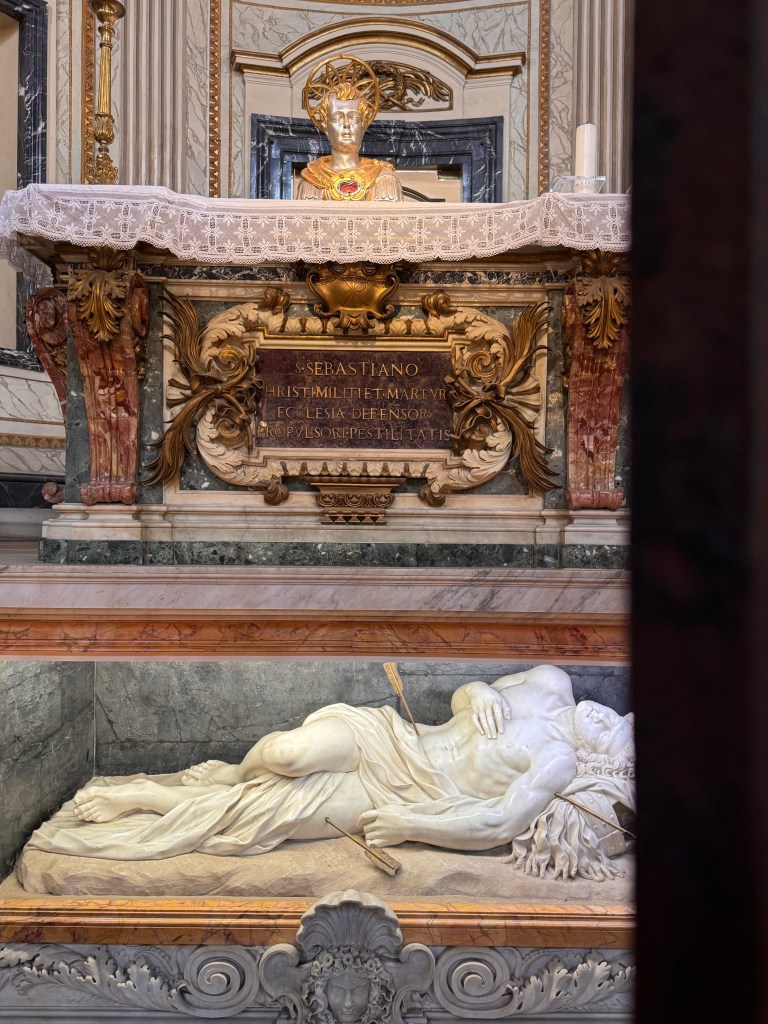
A wealthy woman named Lucina, recovered the body and had it buried in the catacomb over which a basilica in his name was eventually built. Most of the time, the martyrs are shown with the agent of their actual death, but in Sebastian’s case, the arrows were more of the agent of the miracle of not dying. Nothing against a miracle, but Irene of Rome and the Saint Lucina get a lot of the credit for setting up the rest of the story, I think.
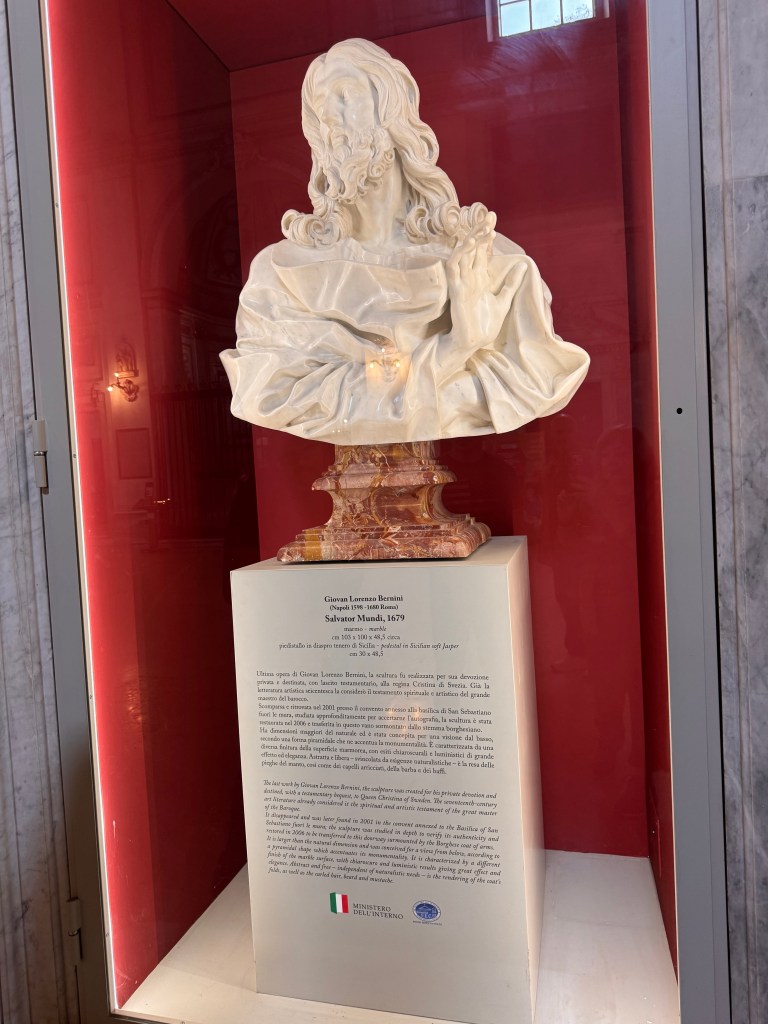
The Basilica of San Sebastiano also has the last work ever completed by Bernini, shown above. The text explains (?) that it disappeared and was only rediscovered in 2001, in the convent annexed to the basilica. The artist left the sculpture to his patron and friend, Queen Christina of Sweden. It seems the work was never transferred. It is a Salvador Mundi (Our Savior.) What the church text does not explain is that the Chrysler Museum of Art in Norfolk, VA, also claims to own a Salvator Mundi that is the last work of Bernini, and was a gift to Christina of Sweden.
And why would Bernini know the Queen of Sweden? She became a devout Catholic, and moved to Rome (perhaps to avoid the stress of royal life.) She admired Bernini’s work and was his patron for the last twenty-five years of his life. Here is an article about that friendship, which carefully avoids taking sides about which bust might truly be the final work.
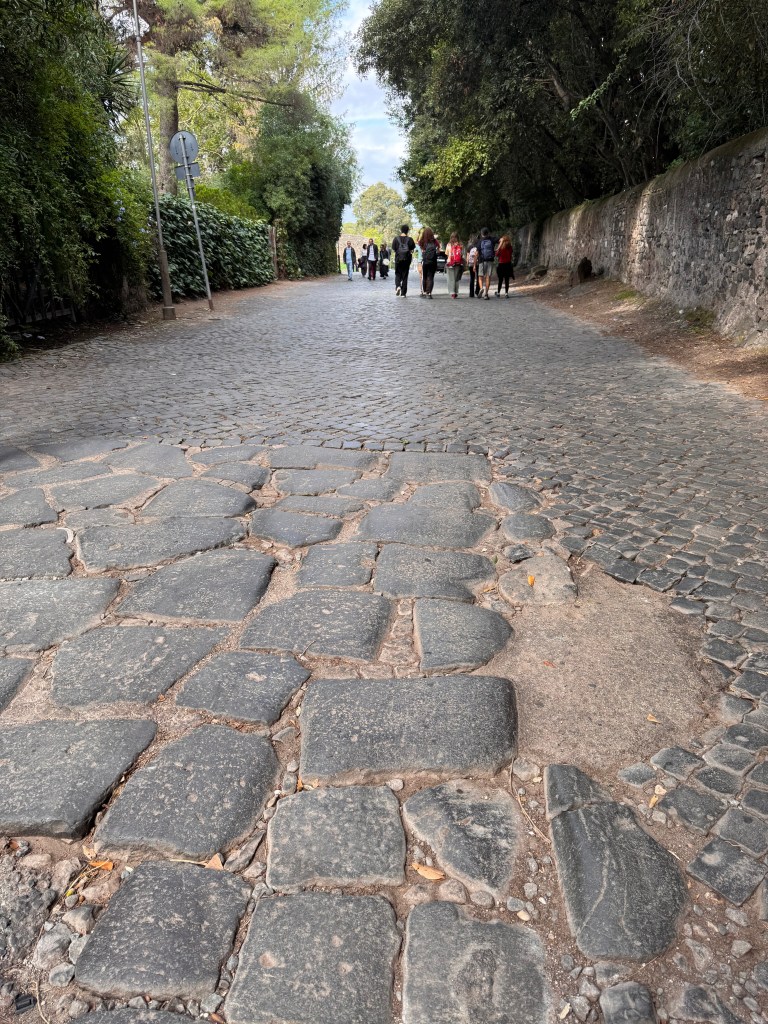
We strolled for a bit along the Appian Way. In the photo, above, you can see a section where the original ancient Roman round pavers have not been replaced by the typical (but still old) modern Roman square pavers. We watched a car bounce and jostle slowly over the old Roman section.

The second site was more of an archeological location. Originally build as a the tomb of Cecilia Metalla, a wealthy heiress who married well, the tower dates to the second part of the first century CE. It became the property of the church, and eventually a palace was built using the funerary monument as a tower, under Pope Boniface VIII (13th century). The great hall, now completely roofless, has artifacts from the many tombs that once lined the Appian Way:

We sat on stools in the space, donned VR headsets, and watched and listened to a reconstruction that took us up three floors of furnishings, and then to an aerial view of what was once an impressive complex.
In future, a longer meander along the Appian Way would be a nice way to spend the day. It looks rural, because it’s long purpose has been somewhat respected (or maybe haunted), though it is surrounded by the densely populated modern Rome.


We wanted to eat light, because our last event of the day was gastronomic. So, we found a pizza with zucchini blossoms, fried olives stuffed with meat, and some interesting gelato. I recommend Fatamorgana to anyone in the neighborhood. It has really unusual flavors, and we’ve observed a constant flow of food tours heading to it. The craziest flavor, that I haven’t tried yet, was black garlic with white chocolate chips. My more staid selections were ginger, chestnut cream & lemon; and pear with blue cheese.
After a siesta, we arrived at our 7:00pm (opening time!) reservation at Glass Hosteria. It’s a Michelin star restaurant by Chef Christina Bowerman. We had a wonderful meal, tasting menu below:
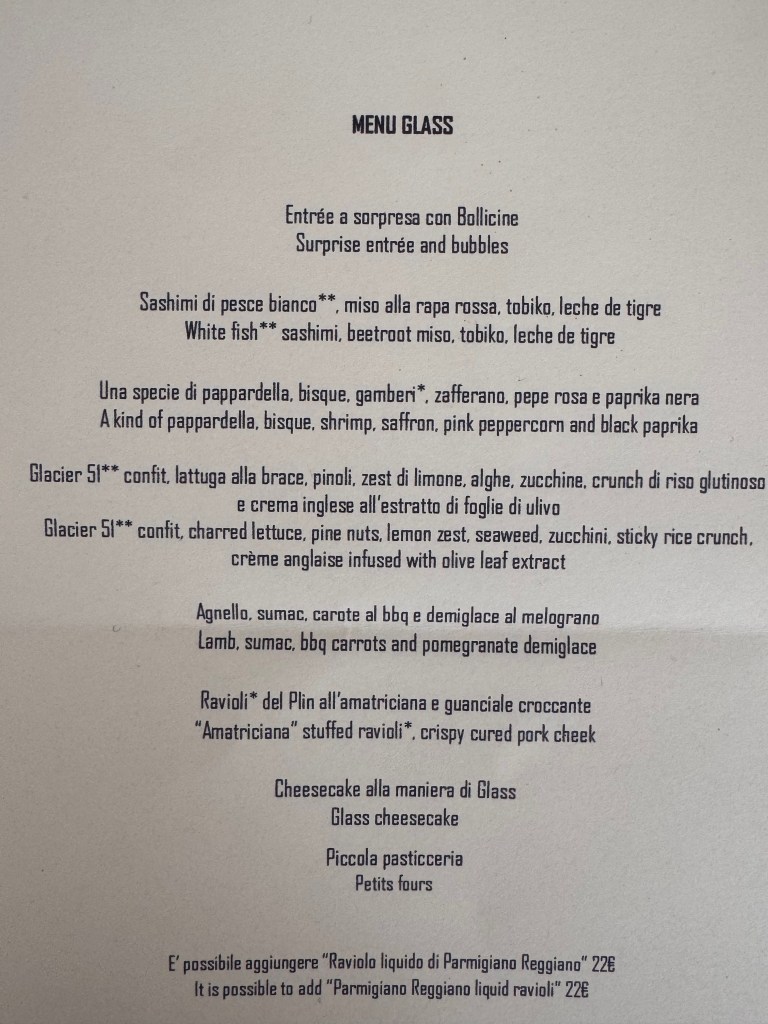
I won’t describe in detail, but will give two ideas that I could partially replicate at home. The Glacier 51 is a cod, and would not be attainable in the USA. But the preparation of zucchini and pine nuts, that accompanied it, might be possible to replicate. It went very well with the buttery cod. Second, I was amazed that the pecorino sprinkled liberally over the lamb really stood up to what is a fairly strong flavored meat. Chef came by the table to chat a couple of times, and she said she was inspired by a lamb and desiccated blue cheese dish she’d eaten in Wales.
Maybe as perfect a day in Rome as I could imagine.


Leave a Reply