


In 1555, Pope Paul IV forced all of Rome’s 2000 Jews to live in one small area of the city, near the Tiber, in an area prone to flooding. With only a few periods of interruption, this ghetto policy continued until 1870. By then, the Jewish population had grown to 5,000, but with little additional land area. Housing had to go vertical, making the narrow streets especially dark, just one aspect of an exceptionally unhealthy part of the city.

We learned this dark history, and more, during a tour today of the Jewish Musuem and Ghetto. We made the arrangement with Context Travel, our second tour with them this visit. It was excellent.
Rome’s Jewish community is still centered around the large and beautiful synagogue in the former ghetto. We spent a great deal of time in the museum, located beneath the synagogue. The fragment, above, is a replica of a grave marker, and has traditional Jewish symbols.

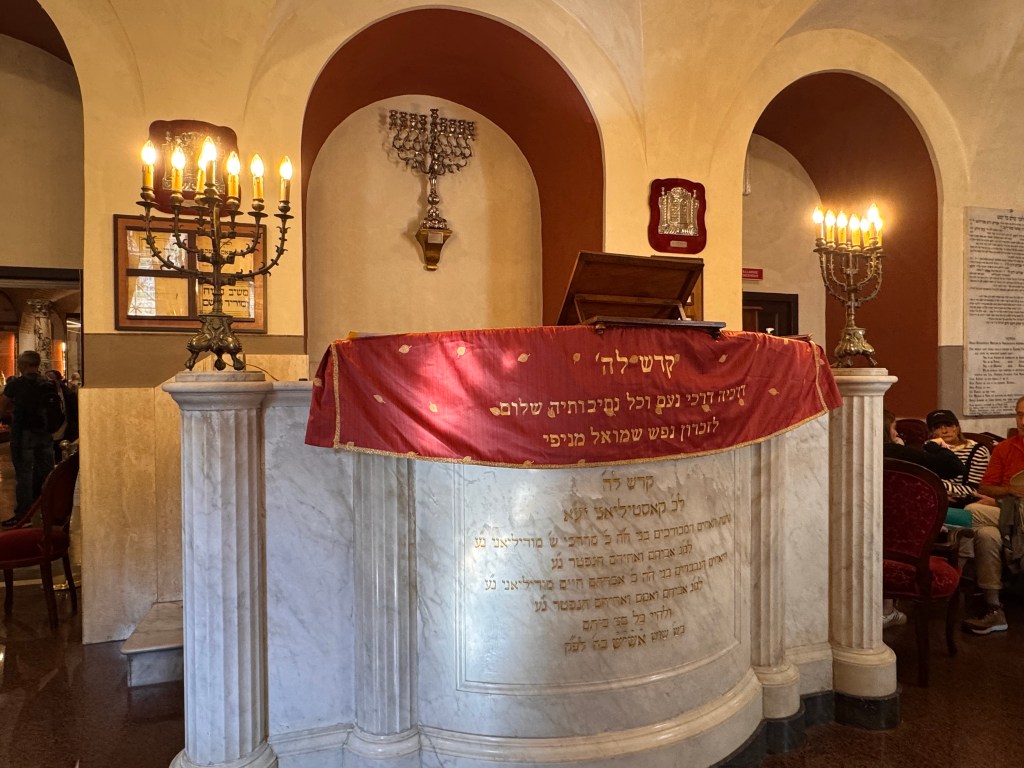

Within the museum is an actively used synagogue for the Spanish Jewish congregation who historically found refuge in Roman during the Inquisition.

The synagogue itself is beautiful. The roof is aluminum, and was shiny before WWII when it was tarnished to prevent allies from using it to navigate to other sites when they were bombing the fascists.
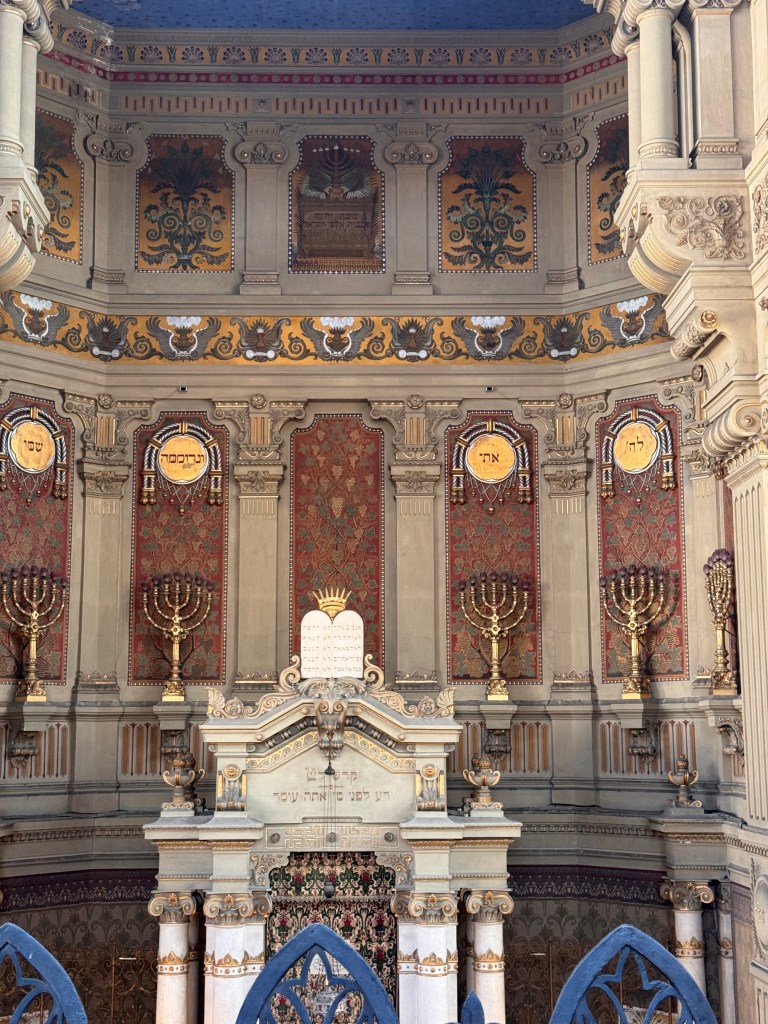

We were permitted to ascend to the women’s gallery to view the space below. It is beautiful and has architectural elements from ancient Greece through Art Deco. Judaism in Rome does not seem to fall into the three American categories of Orthodox, Conservative and Reform. So, the services in this space would be Orthodox. While there are some Reform Jews in Rome, they’re ex-pats who brought their form of Judaism with them here. In all of Rome, there is just one female rabbi. Nevertheless, this synagogue is considered the home of all members of the Roman Jewish community.

Across from the synagogue is a large building housing the Jewish School of Rome, and children will come from all over the city if this is the choice of their parents. When I naively asked how many students attended, I was gently told that they are not allowed to say.

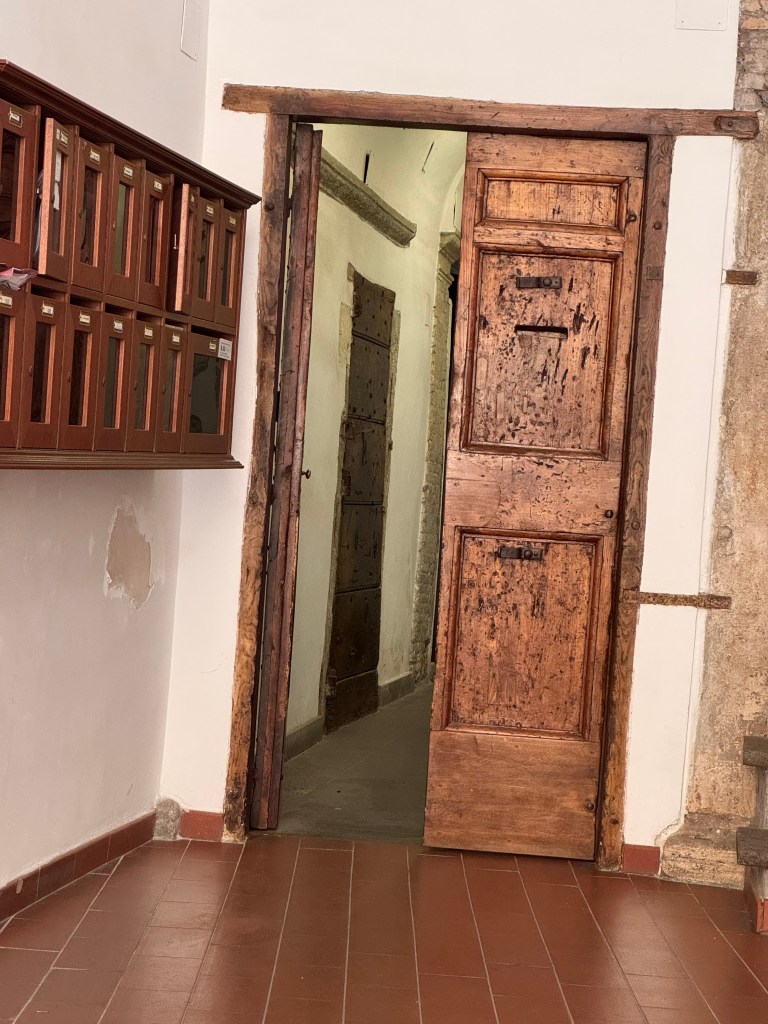
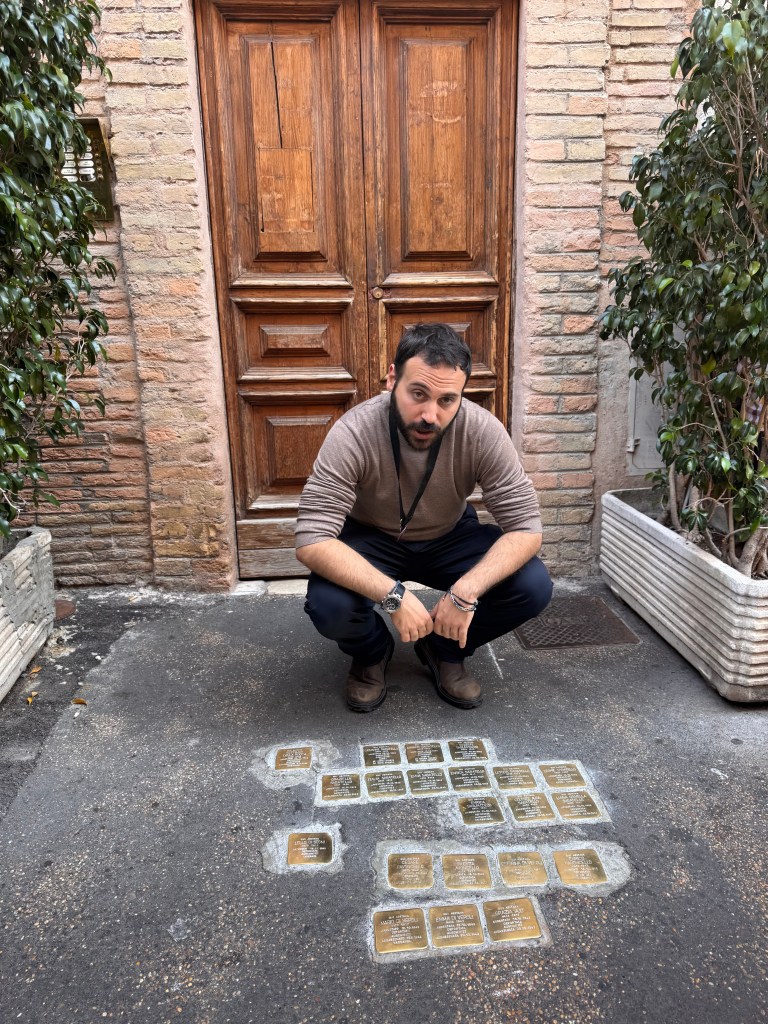
When the Nazi’s came to Rome in the summer 1943, of course the Jews suffered horribly. In September, the Nazi’s asked the Jewish population to buy their protection with 110 lbs of gold, and gave them 36 hours to come up with it. Unbelievably, the community raised the gold– but of course there was no honor to keep the “deal” on the side of the Nazis. The gold was sent to Berlin, and on October 16, 1943, the Nazi’s rounded up 1,023 Roman Jews for deportation to Auschwitz. Only 16 men and 1 woman survived the war.
Many of the buildings in the ghetto neighborhood have brass “stumbling stones” in the pavement outside the doorway. Each has the name of a person who was taken, and the fate of that person. Most say “Auschwitz,” and “assassinated.” They are shiny, like gold. We later found one on the street, across the river, in Trastevere, a few yards from our hotel. Apparently the Jewish community has not raised money to represent each of the 1,023 people, yet.
Following the Mr. Roger’s advice to look for the helpers, we did hear a couple of stories of rescuers. Our guide is a descendant of Roman Jews who survived the Nazi round up. One relative was sheltered by street car workers who let the boy hide and sleep on the cars, and in the storage areas, eventually reuniting him with other family in hiding. Another few relatives where hidden by neighbors.
The best story, though, was of of “Syndrome K.”

There was and still is a hospital in an island in the middle of the Tiber, across from the ghetto. It was a great place to isolate the sick. Some Jews made their way to the hospital and were taken in. From there, three physicians and a priest invented “Syndrome K,” a horrible and highly contagious neurological disease, who’s patients had to be isolated very carefully. All “patients” with Syndrome K were Jews in hiding. Perhaps 100 souls were saved through this bravery.
It was an amazing tour, and introduced us to history and aspects of Judaism that we do not encounter in the USA.
Two food related photos to finish up. The Ghetto is known for having delicious food, and one typical dish is a deep fried artichoke. We had lunch at a kosher restaurant and tried them, along with a pizza. In the evening we went with some of our traveling companions to an osteria. My dinner protein was anchovies, not the canned salted kind, but fresh and arranged in a silver line on top of sauted chickory.


We’re with our Colorado College group now, and depart Rome in the morning.


Leave a Reply