


We are in Umbria! In 2023, this was the area of Italy where we first visited– not very well known to Americans, but it was a wonderful introduction to Italy. In my memory, it remains a highlight location of all places in Italy I’ve been, and I was very curious to return and see if I might have the same reaction. I do. Just feast your eyes on the photo above. Umbria is called the “green heart” of Italy. It has mountains, and valleys, grows olives (and other food too.) It was the home of the ancient Etruscan people, until they were conquered by the Romans.

After about a two hour drive, we arrived in Orvieto, and spend the rest of the day there. It is a walled city, and we were dropped off and walked the narrow street into the piazza where the beautiful Duomo looms. Our first site to visit, though, was Orvieto’s underground.


The hills were a refuge for the Etruscans, and the Romans who followed. The mountains were made of tufa stone, volcanic, soft, and easy to dig. Under the city are multiple rooms and tunnels that have been dug in the soft stone, first by the Etruscans, then the Romans, and then the Italians. The chambers still exist, and are owned by private families, except for the few that are part of the museum. In the photo above, the underground room was used as an olive mill. The coolness of the underground was an ideal way to cold press the olives and preserve the flavor of the oil.


For years, pigeons were raised in the underground also, They did need a window to enter and exit, and little roosting niches that were easily chiseled for them, In this way, a family had an easy source of eggs and meat. Eventually the church outlawed pigeon keeping, ostensibly for security, since enemies could enter through the passages, but most likely to prevent smuggling activities, which could also use the passages and avoid paying taxes.
At some point in Etruscan history, they learned how to dig through the tufa and into the ground water so that no one needed to walk to the valley to get water. This made the mountain all the more secure as a refuge, since water would have been scarce during a siege if it was only accessible in the river below. We saw one well, and it was extremely deep.

There are forty of these wells, known, and some have been re-excavated as over the centuries they became filled with rubbish. The round circles on the inside wall were used as a ladder so that people could climb up and down when the well was being dug.

We had lunch on our own– and the “green heart,” provided great options. A little shopping included, for me, earrings from Stilla Gioielli, who takes her inspiration from some of the floral motifs in the cathedrals decoration. (I don’t have them on in the photo.)

Then we walked back up to the piazza to actually see the cathedral that had been looming over the day.
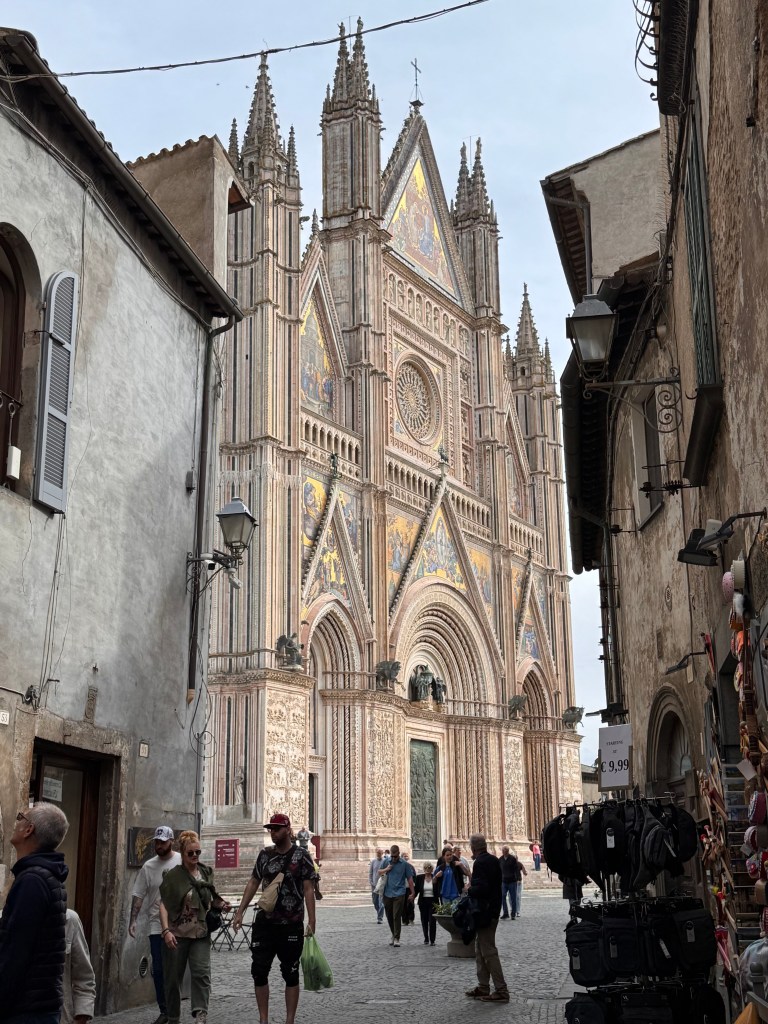


There were two churches here before the cathedral, both dedicated to Mary. One day, in 1263,a Bohemian priest, Peter of Prague, who was visiting the area, found himself experiencing doubts about the doctrine of transubstantiation. During his doubting, he celebrated mass, and when he broke the host (bread) it bled, and his doubts were put to rest. The blood stained the linen of the altar cloth. Pope Urban IV was in his summer home in Orvieto, and had the linen brought to him. I guess if anyone can recognize the blood of Christ, it’s the pope, and on his authority a miracle was declared, an annual feast day of Corpus Christi was born, and in 1290, the cathedral was begun.


One of the chapels inside the cathedral holds the relic of the blood stained linen cloth, which is exposed for the public a few times a year for certain feast days and holidays. The outside decoration of the church, the beautiful gold mosaics, depict events in the life of Mary.
Our last stop in Orvieto, was to walk the double helix staircase to the bottom of St. Patrick’s well. The well was built 1527-1537, but requirement of Pope Clement VII who wanted to insure that he and his army would have water in Orvieto during a seige. It was designed with a staircase winding down the cylinder and another one winding up, so mules and people would not jostle each other on the trip. We walked over 400 steps (200 feet) down, and the views looking down into and then up from the bottom were pretty cool. The only trouble for me going down is that the whole time I am thinking about the work of walking back up! I think I’d always rather hike a mountain than a canyon…


We’re tucked into a Foligno hotel for the night.


Leave a Reply