


Earlier this year I had the interesting opportunity to study Shakespeare’s Merchant of Venice. One significant fact I learned was that Shakespeare most likely never met anyone who was Jewish, as they’d all been required to leave England in 1290. (Cromwell let them back in 366 years later, in 1656, and Shakespeare had been dead for 40 years by that time.) The Venice ghetto is another story of both anit-semitism and the Jewish diaspora.

In 1516, by decree of the Doge, all Jews were required to live in a small island in Venice that had previously held a copper foundry. The Venetian word for foundry was “geti,” so the the term ghetto stems, straightforwardly from that. Unsurprisingly, other restrictions applied: marked clothing; limited (but important) professions like pawn shops, second hand clothing, and medicine; and being locked in at night with Christian guards. Initially, Venice had a small Jewish population, under 1,000 people, but conditions were crowded as the population grew.
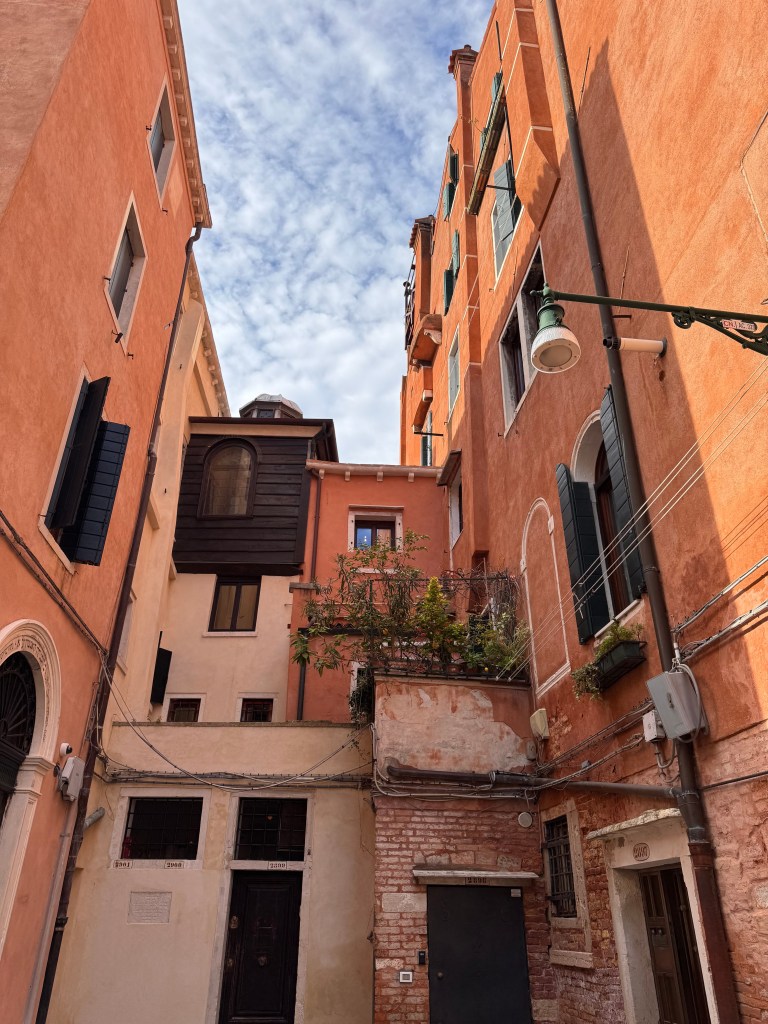
Last week, after a nine year closure, the Jewish Museum of Venice reopened. And we visited today! It’s well done, and within the space you can visit three different synagogues. Worship had to be done rather privately, and no exterior indication of a synagogue was allowed. So you could not see these places of worship from the outside, and they are not on the ground floor (very sensible in Venice, anyway.) There is a German synagogue, and a Canton synagogue, (means “corner” and was built for the French Jews living in the Ghetto) and an Italian one. As various Jews fled hatred in other parts of Europe and the Mediterranean, they might make their way to Venice. The community became intellectually vibrant because they were able to print what they wanted, and the number of world languages available in the community was large.


The living quarters in the ghetto were always dark and cramped. Sometimes rooms with tall ceilings were divided in two, horizontally, and the head clearance is impossible by today’s standards. The museum does a good job in recreating rooms with audio of indistinct voices and human movement to give a sense of a full room.


Eventually, Napolean conquered Venice and ordered the walls of the ghetto torn down. Restrictions were lifted for a little while, until the Austrians were put in charge, and restrictions returned. The walls, though, stayed down. Years passed, and then the Fascists took power. Mussolini did as the Nazis asked, and sent Jews to their deaths in the camps. Venice protected many of its Jewish citizens, but 246 were deported with only 8 surviving and returning. Here are the stumbling stones representing five of those who were killed after being removed from the ghetto in 1943:

I am very happy to have been able to visit both the Venice ghetto and the Roman one on this trip. In both cases, the frustration and anguish about the centuries of persecution is coupled with my genuine admiration for the scholarly and vibrant communities that existed in spite of the hatred. From what I understand, no one in Italy was punished for the crime of sending Jews to their death in the camps, although Nazis were prosecuted for war crimes. Half of the arrests of Jews were carried out by Italians, not by Germans.


We left the ghetto to visit the Sculoa Grande di San Rocca, a fraternal organization for charitable work that houses numerous lush paintings by Tintoretto. Difficult to photograph, I did not concentrate taking photos of the paintings. I do love the story of San Rocco though. He worked with people sick with the plague. Contracting the plague himself, he went to the forest to die. His little dog, though, came to town each day and returned with a loaf of bread. So, Rocco lived and was made a saint. The little dog was not made a saint, but at least gets to be in statuary. It would never, ever, occur to my dog to give me food.

We had the afternoon and evening on our own. We went to the Accademie to look at paintings. We were not as sharp as we like to be in museums, and began to lose concentration. Departing the museum, we found a beautiful setting, sunlight on the bridge, stumbled into a Chihuly glass exhibit, and did some shopping on the way back to the hotel.


Leave a Reply