

We’ve arrived! For some reason, TSApre did not show up on my boarding pass and I was sent through the regular line. I have a renewed appreciation for TSApre, especially at a busy airport like JFK. That was it for glitches though. The flight was smooth, although American seems to have discontinued even beverage service in Economy. They brought around water, and I asked for cookies and did get the Biscoff. The important point is, we’re here!
We were met at the airport and the driver said to me, “As soon as I saw you come over, my soul returned to my body.” Quite a greeting, and to be honest, I am not sure I’ve ever had that effect on a person before, especially at first meeting. I hope all is well with his soul because it is unlikely I will ever see him again.
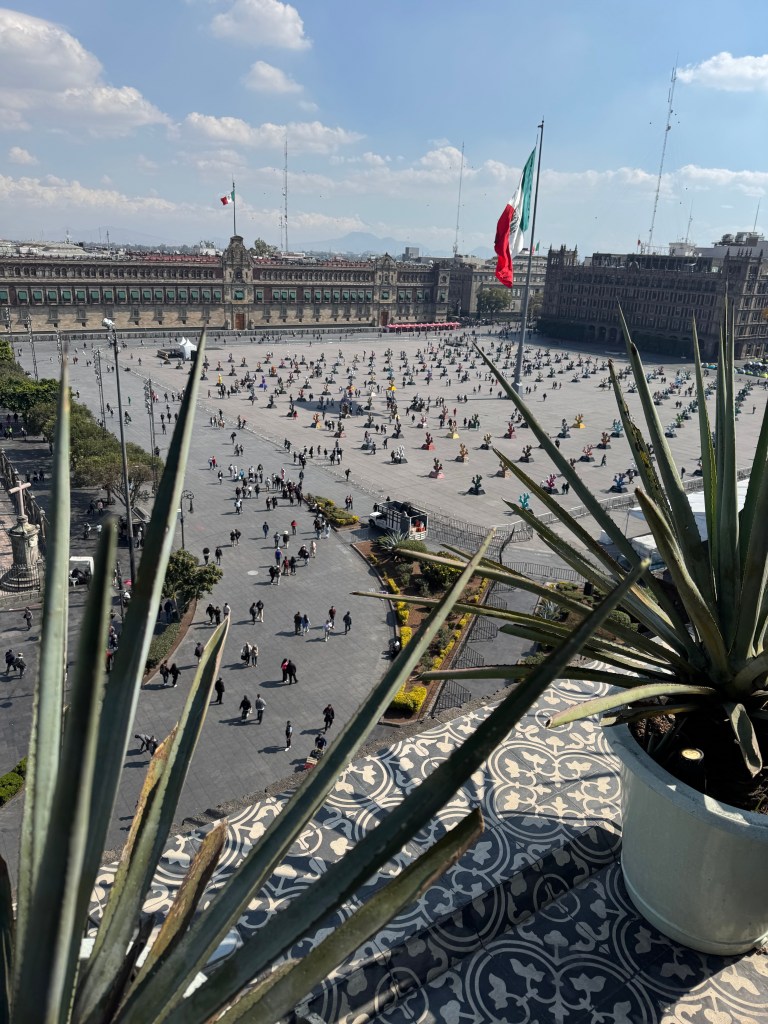
Better yet, because this is an alum tour, I was also met with hugs when we arrived at the hotel, and a plan to share a delicious lunch over looking the historical main plaza, called the Zocalo.
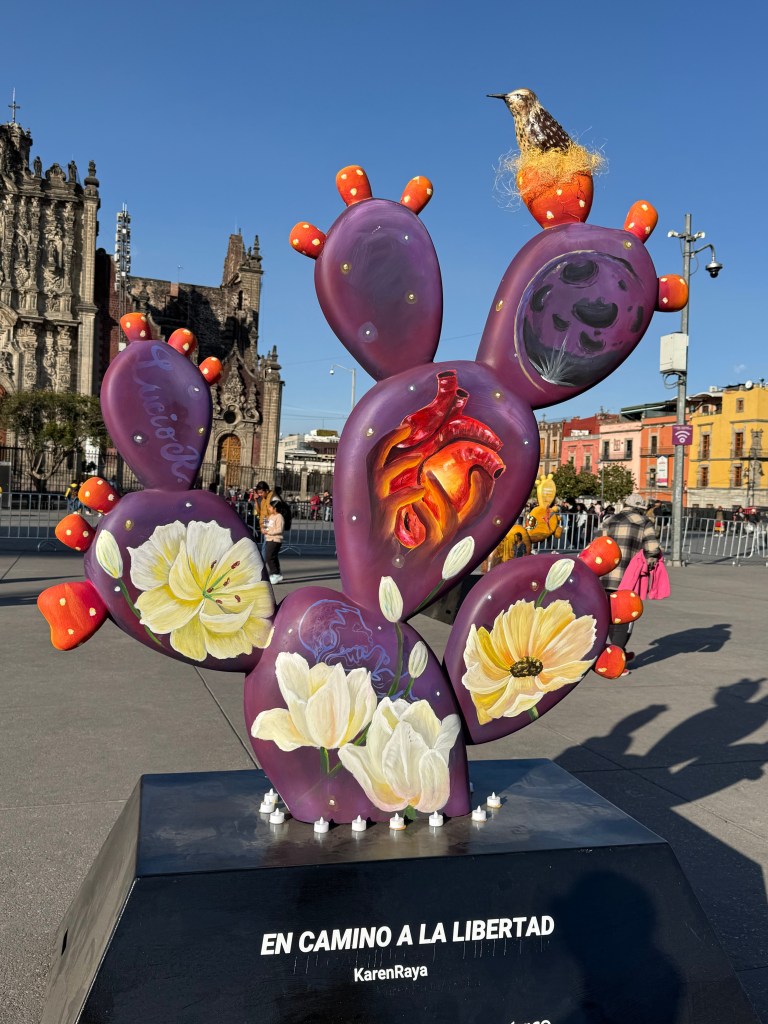
The Zocalo is beautiful. Surrounded by a cathedral, and government buildings, it is currently filled with models of saguaros, painted and decorated by artists. We loved walking around them after lunch. It is the third largest plaza in the world. (I’ll put the names of the two that are larger at the end of this post, in case you want to guess first.)

The area has been a plaza since the people we’ve historically called Aztec, but who called themselves Mexica, established residence on what was basically an island in the middle of a series of five connected lakes. The plaza, called Zocalo, was the location of Mexica temples, military buildings, palaces, and a university. When the Spanish ended Moctezuma’s reign, they took down Mexica buildings and rebuilt buildings with analogous European purposes in the same location. Today, then, we were surrounded by government buildings, a palace, and a cathedral, generally constructed of the same stones that the Mexica had used, but in colonial shapes.

We’ve had a tour of the cathedral and have been introduced to Our Lady of Guadalupe, the most important Christian figure in Mexico. I would say she also has some standing in the US, too.


And we’ve had lectures from both of our professors. Because this is a study tour, we have some guiding questions to keep in mind. Here are a couple, in my words, not necessarily exactly how our professors put them:
- How does Mexico forge a national identity out of a history that included not only colonialism from Europe, but also several indigenous people that never considered themselves Mexican?
- How do the food traditions reflect culture and where can we see European and traditional foods blending?
- How do physical object help a culture define itself? And how do these object help a traveller to define and remember their visit?
Finally, we had dinner. Mine was accompanied by a miraculous margarita that never seemed to reach the bottom of the glass. My main, a white fish with a beautiful green pumpkin sauce, was garnished with pansies.
The most interesting food we were presented with was ant caviar– actually ant larvae served with guacamole. The shape is not as spherical as fish roe, and they are larger too, but the snap and then soft mouth feel means the name “caviar,” makes sense. Yes, Gentle Reader, I ate some. This was mind over matter for me, and I don’t regret trying a few but would need more desensification to order them myself.


Which plazas in the world are larger than the Zocalo? Red Square and Tiananmen Square are larger.




Leave a Reply