

Yesterday we were introduced to Our Lady of Guadalupe. Today we visited the home of another leading lady of Mexico, Frida Kahlo. From a life of pain, passion and some deep disappointment, she created fascinating paintings. Images of her self portraits are everywhere, including in the living room of our home. Naturally, she means different things to different people. Our first stop today was her home, La Casa Azul.


Her story is well known and filled with so much tragedy and drama that it might be over done were it a novel. After surviving polio as a child, she was left with an atrophied leg. Then a street car accident left her with many broken bones and an impalement that meant she was unable to bear children. She and Diego Rivera fell in love, but it was a complicated relationship with infidelity and strong personalities. Meanwhile, they were both trying to shape the future of Mexico as a just society for all, through art and political involvement.


We left La Casa Azul and walked through the neighborhood market. We had a masterful tour, moving rather quickly. There were not many shoppers so it was easy to see the huge variety of spices, clothing, toys, meats, vegetables, fruits, cooked foods, herbal medicines, and much more.


We strolled through the square and and nearby church. This area of the city, Coyocan, is named after the coyote. The corner of the church door has one in the frame because the early colonial legend is that a coyote hunted turkey and brought the birds as a gift for the priests, showing approval for the Catholic religion to be embraced by the people.


We had a huge and delicious lunch. The culinary adventure was trying chapulines, little roasted grasshoppers. Whenever they are described, the amount of protein is always mentioned. A major realization for me over the past two days has been that for centuries, people in this part of the world struggled to acquire protein. Except for wild turkey, and deer, pre-columbian people who lived inland did not have meat. Grasshoppers are at least 60% protein by dry weight, so every 100 grams of grasshopper would have over 60 grams of protein. Since they are wild and live on alfalfa fields, many people would have had access to them.
Easy to understand, and I did eat them, as you can see. They were salty, limey, and crunchy. There were no discernable body parts because they were so small. I never quite got it out of my head that I was eating an insect, though. Lots of people at the table had several helpings, but there were plenty left at the end of the meal.


Our after lunch visit was to Anahuacalli, Diego Rivera’s collection of pre-Columbian art. It’s a gallery and an atmosphere. The building was designed to house the collection and has Mayan and Aztec elements. It is dark inside and the cases of artifacts really pop. The items are not labelled, so we didn’t learn dates, or even the formal names for the figures.


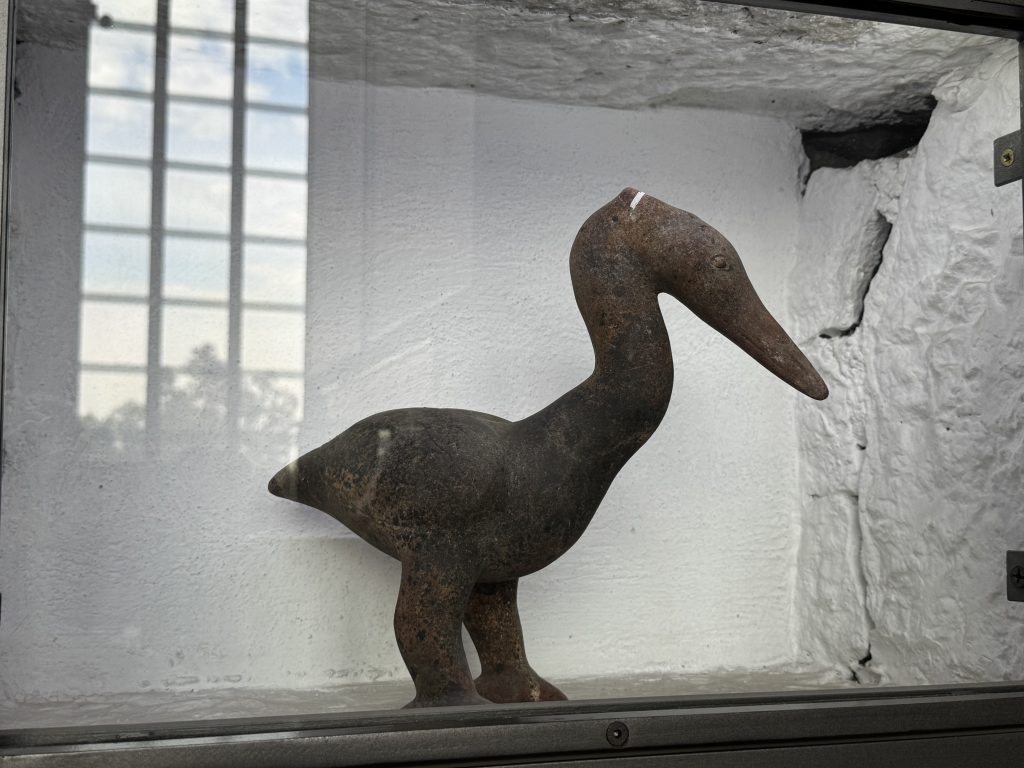


We did learn that disfigurements were seen as positive because they were unique and closer to the spiritual world. Also, time was not linear and death was not an end but a start to entering the spiritual world. Rather heartwarmingly, animals are special because they have special talents, like seeing in the dark, flying, or having a hard shell. Dogs, especially the Mexican hairless dog, are very special. When a person arrives at the spirit world, they are met by a dog who acts as a companion through the sequence of the spiritual world. Sounds like heaven to me!


If the idea of having a dog companion in the afterlife doesn’t move you, hearing about our last stop might. Imagine a university education at the cost of about $15 at semester no matter what. Throw in three meals a day for a few dollars each. How many students do you think your society could educate with a plan like this?
National Autonomous University of Mexico educates 250,000-350,000 a year this way. We visited to view the Juan O’Gorman mural which is integrated into the library as a mosaic created out of very large pieces of stone that make up the structure of the facades. It’s magnificent, and I imagine you could see it every day and notice something new as the years go by. The mission of the university, to make education available and free for everyone, is very moving. The university commands great respect.


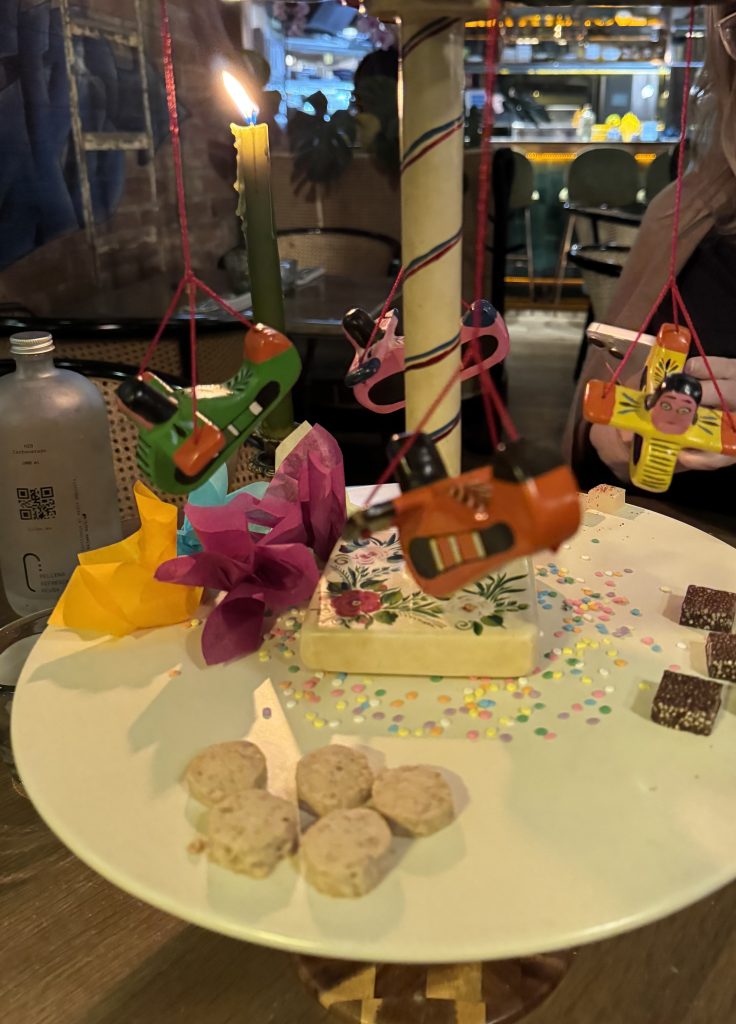
Finally, the day’s sensory saturation ended with a meal at Filigrana. I had lengue, which in my family is called “tender beef.” The squeamish won’t want to look up the translation. It was delicious. The delightful tiny cookies came complimentary at the end of the meal. The company was excellent and I highly recommend this restaurant if you visit Mexico City.
My final thought after today’s activities is that I wish I could relearn North American history from west to east instead of the traditional way, from east to west. Even as an interested person with exposure to some aspects of Mexican culture, I’ve had a woefully incomplete education. Glad to be making up for some lost time now.


One Response
I’m enjoying your personal travelogue and pictures. Sounds like a wonderful learning everyone on many fronts! Lady, the writing is wonderful!
Best, Barb