Today was full and it made a perfect arc of the themes of history and culture we’ve been examining. It’s taken me two days to write about it because it was such a full day.
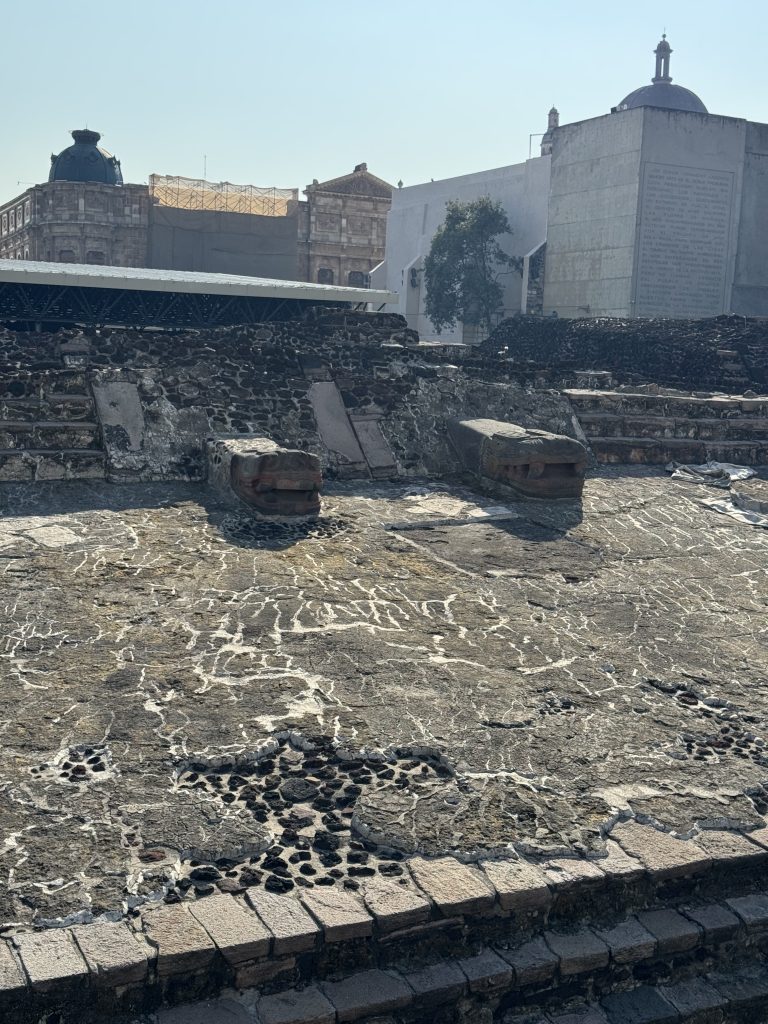
We began with a short walk from our hotel, around the corner from the Zocalo, to an area bordered by the cathedral on one side. Here, the government has preserved and excavated some of the Mexaca ruins that the Spanish built their colonizing buildings on.
(I am using the term Mexaca instead of Aztec because it is the name the pre-columbian people called themselves.)
The Mexaca built temples in layers (“Like a Russian doll,” our guide said.) Each temple was supposed to reach 52 layers. While the buildings are sometimes called pyramids, due to their shape, they are not burial sites or death monuments like the Egyptian pyramids. Temple is better description, based on use.

After looking at the ruins, we headed to the the former education ministry building that is now a museum of the murals that Diego Rivera created to help forge a Mexican identity. The building itself is very pretty. A former convent, it is built around a large courtyard and is three stories tall. The building itself, then, is a reflection of the conquerors, Europe, and the colonial period. Within that setting. Rivera was tasked with describing what a post Revolution (1910) Mexican identity should be, and he was working about one hundred years after Mexico gained independence.

Rivera painted over one hundred murals in the building, so naturally, I did not photograph them all. The purpose was to define the Mexican people, not as a group conquered and in the style of Europe. The answer to how to define a modern Mexican people, we learned, was to look to their past. By demonstrating a common past, the thinking was, they could forge ahead. The people descended from those who lived here pre-contact did not consider themselves to be one group, of course. And, there are few people who don’t have ancestry that is both Indigenous and European. But, I can see that being able to define a national identity that does not strongly rely on history of being conquered and colonized would be an optimistic way to move forward. An identity based solely on being a victim is not very empowering.


I’ve never been able to see a Rivera mural before, and to see so many that were painted for such a targeted purpose was really thought provoking. The murals are dramatic and represent strong opinions. Rivera was a communist and his art supports workers and Indigenous cultures. The series on the ground level that is more or less chronological in telling the history. Next it moves into a series about the types of work people did.


On the upper levels, the work becomes more editorial, showing capitalism and even specific tycoons from the US as harmful and bad. It’s a very good experience to be able to understand how an important citizen of another country viewed your own country. As Rivera designed the murals, his present day thoughts were very much engaged with what the US was like at the time. He’d be pressed to come up with much progress.


We walked to the San Juan market to meet some guides from Mexico Eats. In smaller groups, we had a fantastic food tour. Our location was the San Juan Mercado and it is a large and old market. It sold imported goods for years, so was known as a gourmet market. We tasted salsa (in the general sense of sauce, not tomato-chili mixtures), grasshoppers and corn nuts, fruits, and cheeses in the market.
We moved out to the streets and tasted street food: blue crab tostadas, tacos al pastor, and turkey torta. When I expressed an interest in a vendor selling peanut and amaranth candies, our guide purchased some and we even got to try those.
The tastes were all wonderful, and here is a list of some interesting items, paired with photos from the maket and listed in no partiular order:


- Mexico can grow anything it wants or needs, and can get several harvests in a season;
- In the photos above, only the mango in the upper left was something I’d eaten before.


- There still is not a strong cheese culture in Mexican cuisine. Dairy and beef cattle were introduced from Europe, so cheese is not part of the indigenous food culture. Although many other European introductions have been extremely well integrated, cheese has not. (I found this interesting. New Zealand, which also has an ability to grow just about anything and ample grazing land for the introduced dairy animals, also does not have a strong cheese culture, yet.)
- Mexicans do not bury food in cheese the way tex-mex items are. Rather it’s used like a seasoning. The dry cotija, for example, would be sprinkled on top like a salt.


- Turkey is the sole native meat and it was not a domesticated animal. Fish and seafood were also a big source of meat. The ruling classes of the pre-Columbian Mexica had relay runners to carry fresh fish to the capital from the sea each day!
- Fresh lime squeezed over just about anything makes it taste good;
- I saw a lot of dried shrimp in the market. I would not know how to work with this ingredient but it might be worth investigating. It was not part of our tasting.


- Al pastor is not a very old style of taco. It’s origins are the the immigrant Lebanese community and it is related to shawarma!
- You would make a taco at home out of anything, much the way we in the North would make a sandwich from ingredients at hand. But certain types of tacos, like al pastor and barbacoa would be eaten out, because they are complicated to prepare;
- All the marinated meat to make al pastor has to be served the same day it is placed on the spit. So a large spit of meat means the food stall plans a brisk business and it’s probably an excellent flavor and local favorite.


Yes, I again ate the grasshoppers! It gets easier each time, and the garlic or lime flavors are the ones I like best. This snack tray also had corn nuts and mixture of dry roasted peanuts and dry roasted garlic. This last combination tastes best with both the nuts and garlic in the mouth at the same time.

Our last nosh was to try a Mexican torta, which is a sandwich, not a cake. This tiny takeaway shop specialized in pretty much one type of torta: turkey and avocado. It was delicious. I walked over to the cauldron and the chef was happy to let me snap a photo, and he obligingly held up a piece of the meat out of the sauce. At first bite, I thought the turkey tastes a lot like ham. This sometimes is the case when turkey has a smoky flavor. In this instance, it may be because the turkey was actually cooked with pork in the cauldron. This shop has been selling those tortas at least since the mid 20th century.
I told myself I didn’t need a nap since we’d been walking between each eating sample, and that meant I wasn’t as full. This self-lie was necessary because the rest of the afternoon would be spent at the national anthropological museum.

The museum is an interesting building, and includes the umbrella fountain, above, and houses a vast collection of pre-Columbian objects. The galleries are arranged so that they more or less present a timeline of the communities that were in power in the years before Cortes arrived.


Our guide told us about the difficult-to-learn-about history that involved human sacrifices and ritual cannibalism. The colossal heads, above, were made as a monuments to deceased rulers.

There are similarities between the Mexaca empire, and the Roman empire. The Mexaca were not really colonizers. They were migrants from the north, in what may be the Four Corners area of the United States, today. They were granted an island of poor, swampy land by the Toltecs, people who were already inhabiting the area of today’s Mexico City. Because the Mexica were excellent builders and excellent soldiers, they mastered agriculture and began to control larger and larger areas. They did not eradicate the Toltecs, who had already lived in the area, but they did tax them. In the above photo, the codex shows tax records and the product around show some of the goods that were paid in tribute. Cacao beans were important and like a currency, as was corn and pottery, and humans.
A huge surprise to me was that the Mexica ruled for only 79 years before Cortés arrived and brought things to a close. Of course the Mexica arrival in the area and the process of becoming the rulers took over two hundred years. Like the Romans, the Mexica were successful because they were good builder, engineers, warriors and administrators. Both the city and Moctezuma were impressive to the Spaniards, and the Spaniards were welcomed. Cortés was in the Americas to conquer though, though the first battles were lost by the Europeans. Eventually the European diseases caught up with the capital city and a very weakend population was defeated. The aftermath brings us to Mexico today.
We had one more event, in the evening. We visited an area where working people go to hear mariachi music, have a drink, and eat some snacks. A couple of photos: