


Before a walking tour this morning, we had an interesting lecture from our professor, Leslie. The new learning for me was that when Cortés marched from Vera Cruz to Tenochtitlan, he recruited an army from other indigenous groups to help him. The Tlaxcalans were the most important of these alliances, and contributed as many as 200,000 soldiers. The alliance protected some areas from being fully administered by the Spanish, at least for a little while. Often times the description of the conquest explains how small Cortés’s army was, and emphasizes the guns and diseases as being important. But certainly the additional soldiers had a big impact on his ultimate success.
It is also always wise to note that people who are unhappy with the ruling class will always be eager to find a way out.
Another interesting new understanding for me is that Cinco de Mayo is a Puebla specific celebration. California has many citizens who are of Puebla descent, so it has become a big celebration in the States. But it is not an important holiday in Mexico, except in Puebla, where it celebrates the city’s defense against the French in 1862. The French were here because the wealthy classes tried to sell Mexico to France as they were displeased with the equity policies of Mexico’s first and only indigenous president, Benito Juárez. Another good reminder: you can’t sell your country to another country. And the person with equitable practices is the one who ends up a national hero, as Juárez has.
Thank you, Leslie! After decades of being your friend it is such a pleasure to be your student and see your academic prowess on this trip!
We set out on foot for a walk to a famous library, Biblioteca Palafoxiana, considered to be the oldest public library in the Americas. Now housing 45,000 centuries old historic documents, the collection was begun by donations from Bishop Palafox. He donated about 5,000 volumes in the beginning on the condition that they be made available to the public. It’s a beautiful space, made with wood from a Mexican pine. The room seems airy and has a nice scent– not musty. Between the climate here in Puebla and the wood, the documents are very well preserved.

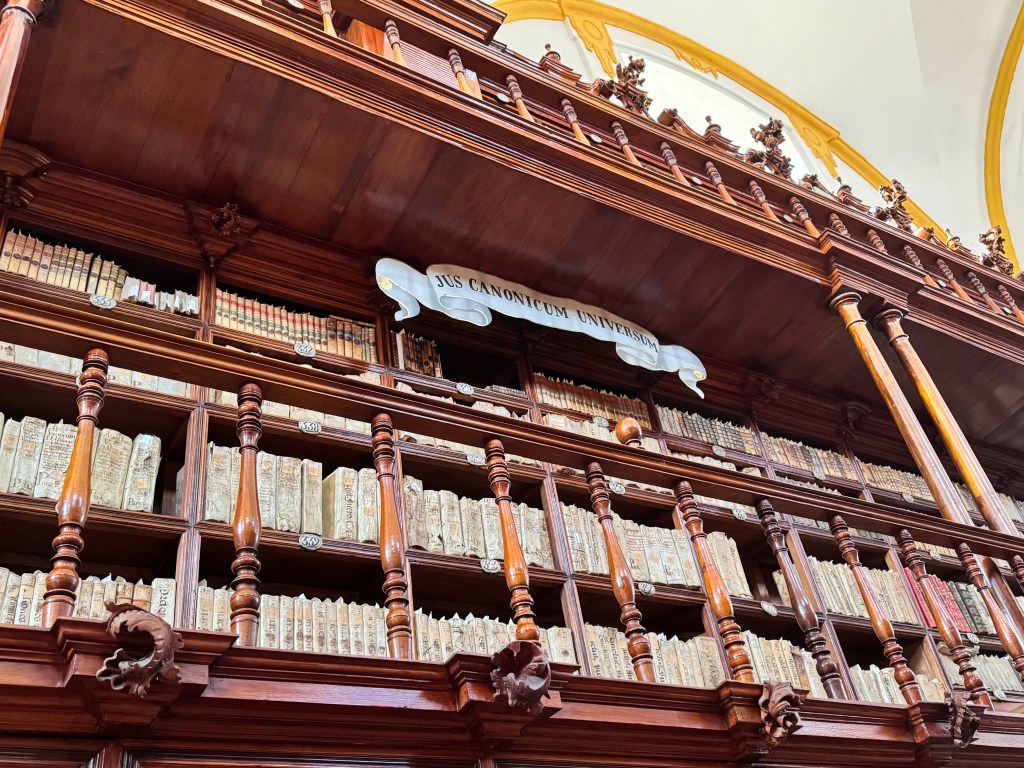


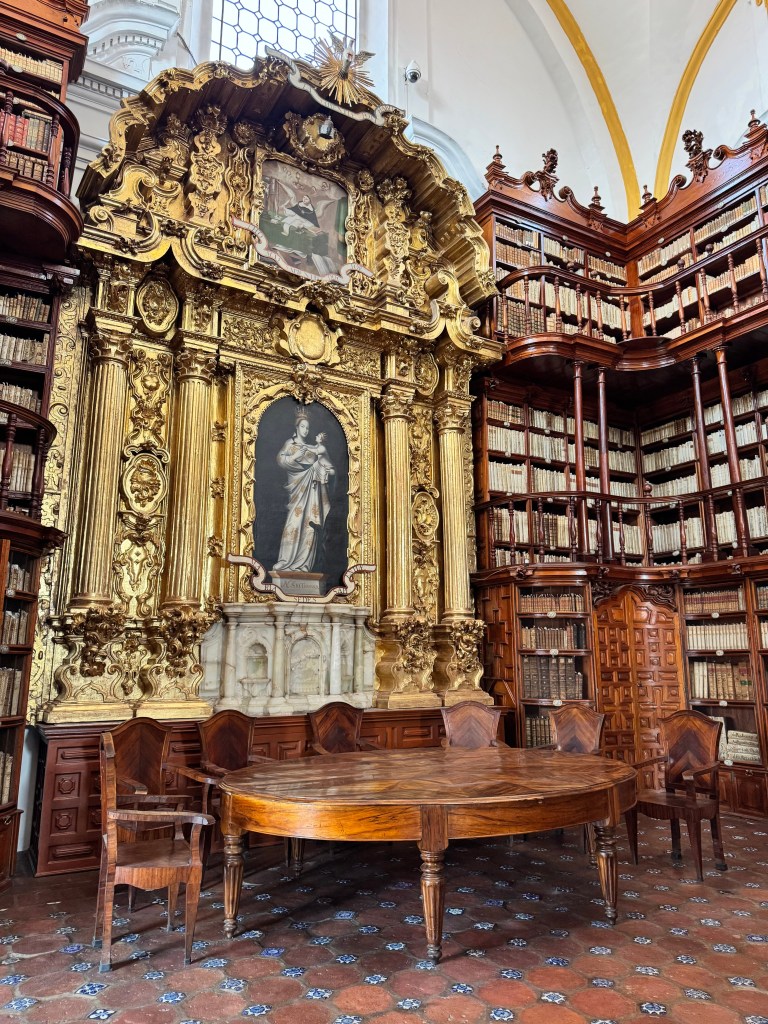

The third level was added in the 19th century and was the last renovation. Because all friars had to learn the Indigenous language, the collection is especially rich in dictionaries.

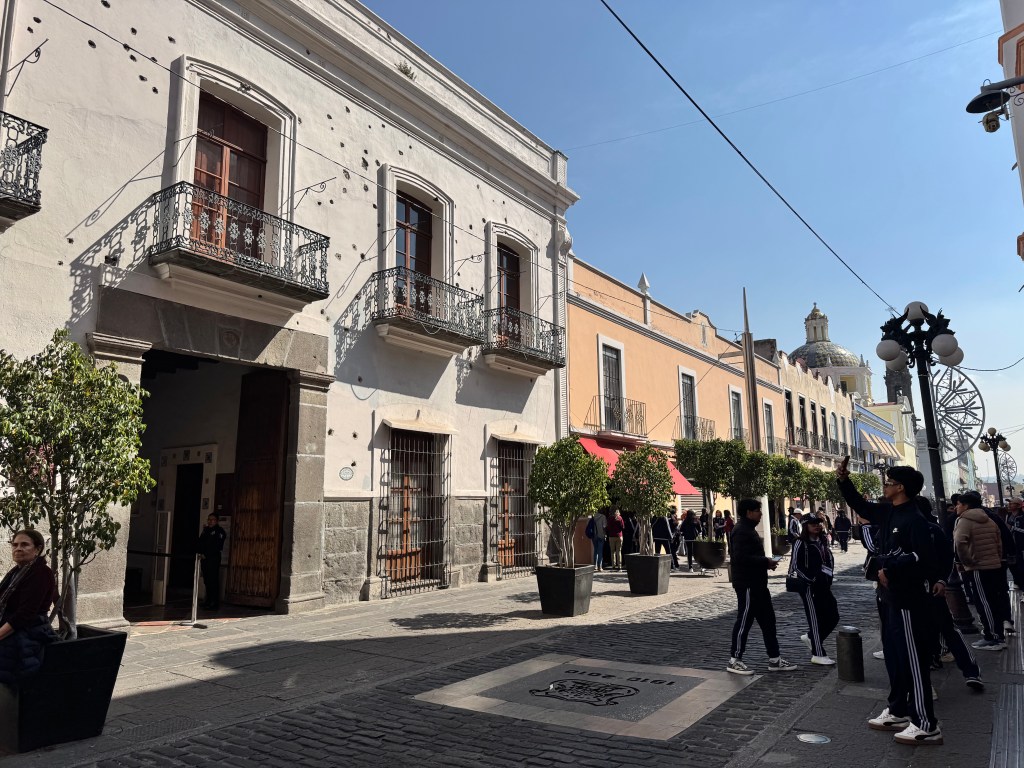
We continued our walk past a historic building that is seen as the start of Mexico’s revolutionary war in 1910. Two brothers, who were plotting to start an insurrection, were shot at in a building they were staying in. They hid but were later captured. The bullet holes are still in the facade, and all nearby local students have a field trip to the site at some point– we saw a group today.
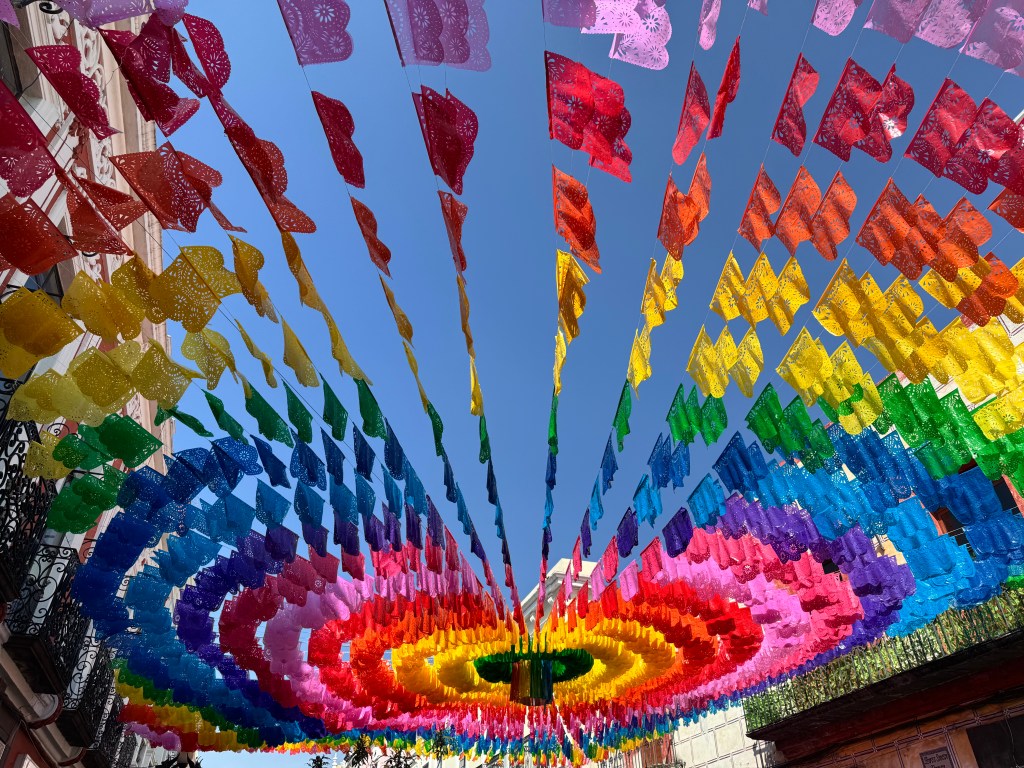
The street had a nice papel picado overhead:
We walked over to the Temple of St. Dominic, which holds the magnificent Chapel of Our Lady of the Rosary.

The chapel is another example of Mexican Baroque. The ceiling medallions of faith, charity and hope lead into divine grace. It has an extraordinary amount of gold leaf.

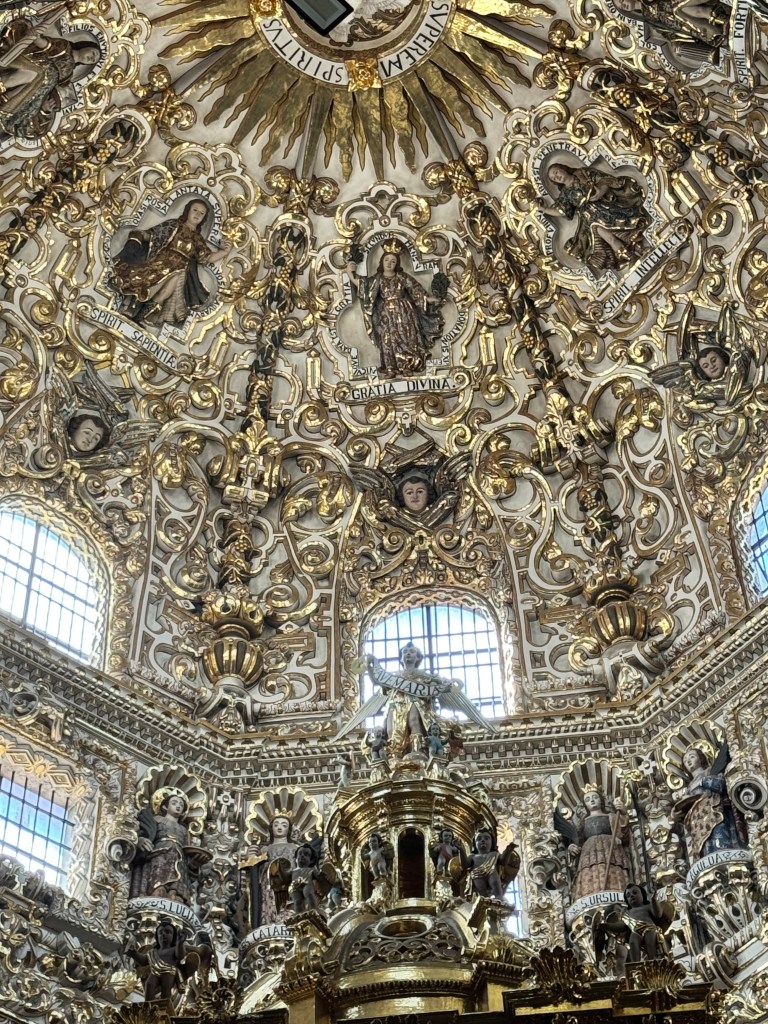

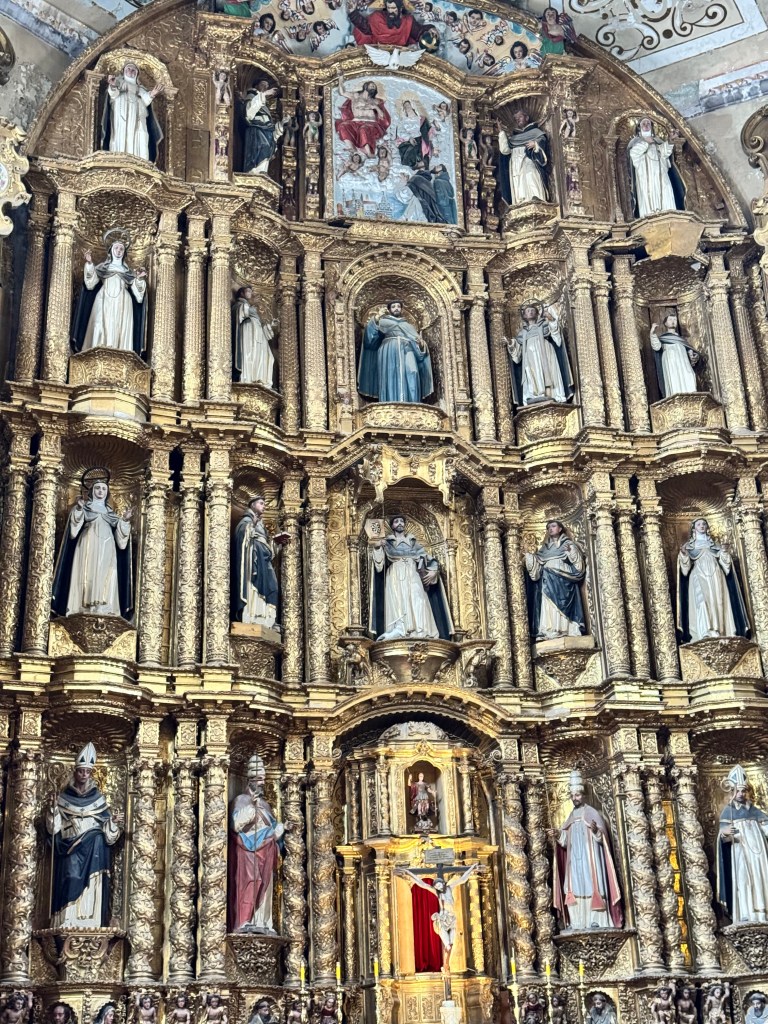


Another short walk and we arrived at a traditional restaurant to eat mushroom soup and chicken with a red and a green sauce.

After lunch, Mark and I took a stroll and visited the Cathedral of Puebla. Like the Metropolitan Cathedral of Mexico City, the one in Puebla also did not have a center aisle, which seems to be due to the addition of a massive pipe organ.
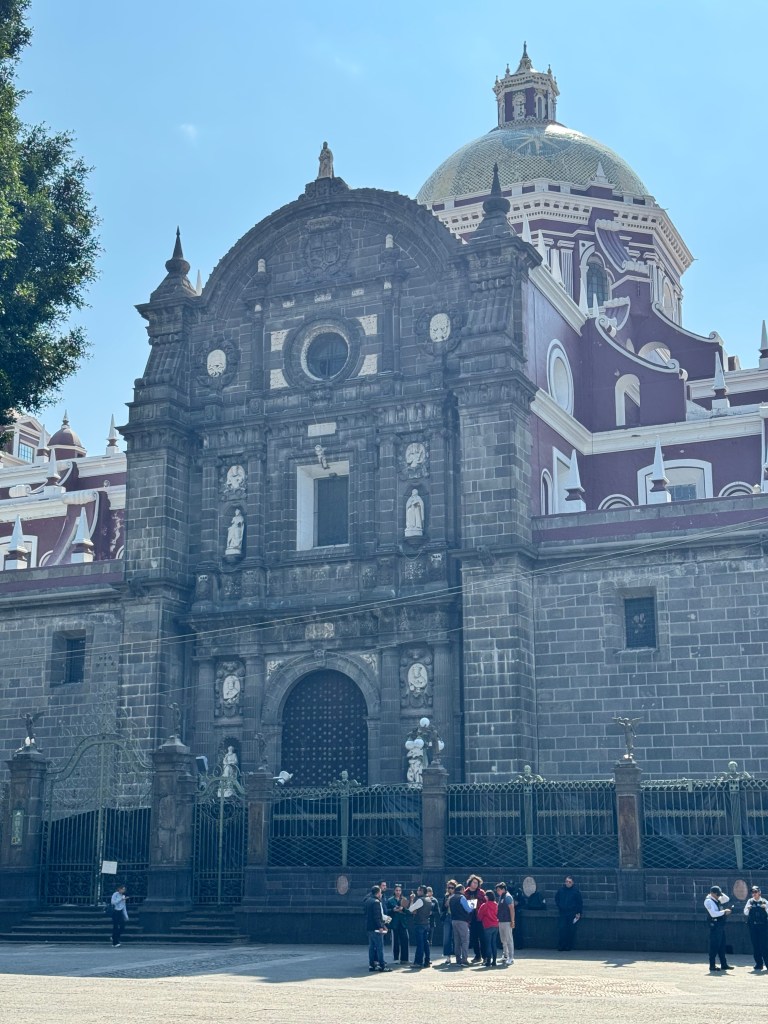
We were also wondering why the cathedral has such a massive iron fence around it, but we haven’t been able to learn the answer.
In the late afternoon we walked to a market that sold souvenirs and had a street of painters, and another street of talavera. We’ve been happy to walk today since tomorrow is a long bus ride.
Dinner, after all the big meals we’ve had, was churros, chocolate sauce, and hot chocolate.




Leave a Reply