


We had a long road trip out of Puebla to Oaxaca today. We have to view the journey with a sense of appreciation though. Cortés could not have easily traversed the route we drove today, so Oaxaca was spared some of what the Spanish brought, at least for a while. Indeed, the toll road we drove today for six hours was only finished about thirty years ago. Just a few decades ago, our journey would have been extremely long, and probably not part of this trip.


The landscape has changed quite a bit. We crossed a mountainous desert with numerous species of cacti, yuccas, agaves, and other succulents. When the toll road was built, a botanist, Dr. Helia Bravo-Hollis, valiantly tried to save as many old large plants as possible by transplanting them to the ethno-botanical garden in Oaxaca. Only about 1/3 of the transplants survived, but that’s better than none. It surely was very difficult work. She has the name “Mother of Mexican Cacti,” and lived to be 100, dying in 2001. She was also the first woman to have received an advanced degree, in biology, in Mexico.

Little wonder then, that a very fun (and too quick, according to Mark) leg stretch was to visit a succulent along the way. The species is called a candelabra cactus, but it is not actually in the cactus family. Rather, it is a euphorb, related to poinsettia. Cacti and some euphorbs are both adapted to very arid environments, so they show a convergence of features that make them look like they share a closer ancestry than is actually the case. This particular candelabra “cactus” is thousands of years old. I got a little misty eyed watching the members of our group delight in getting their photos taken underneath it.

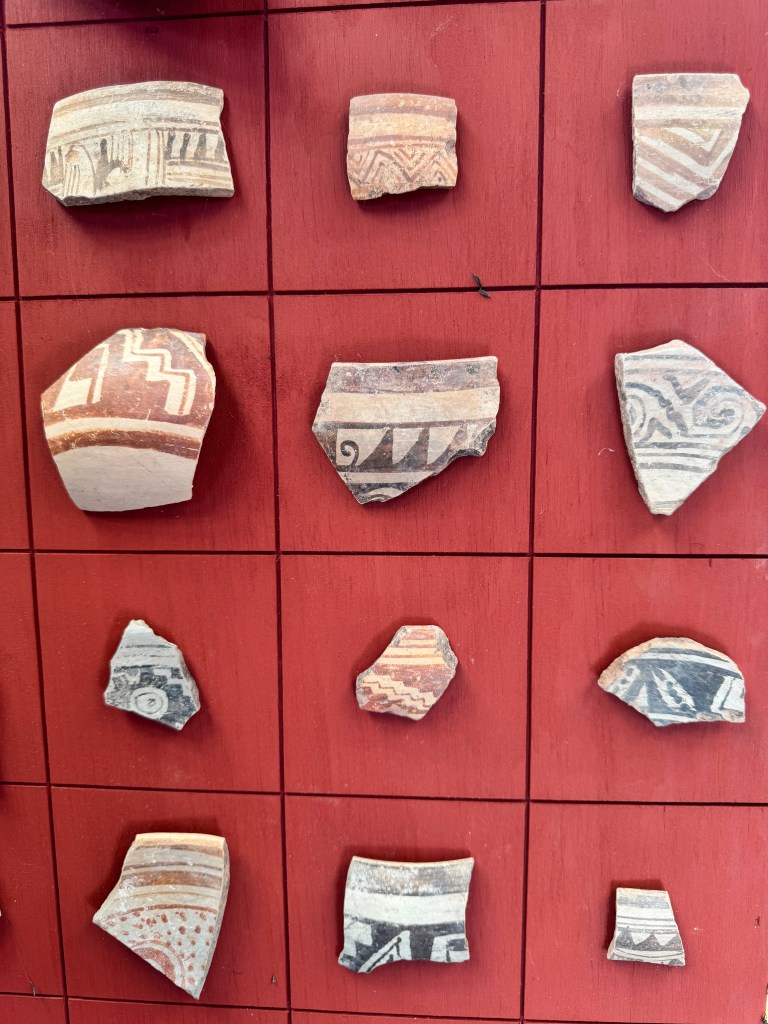
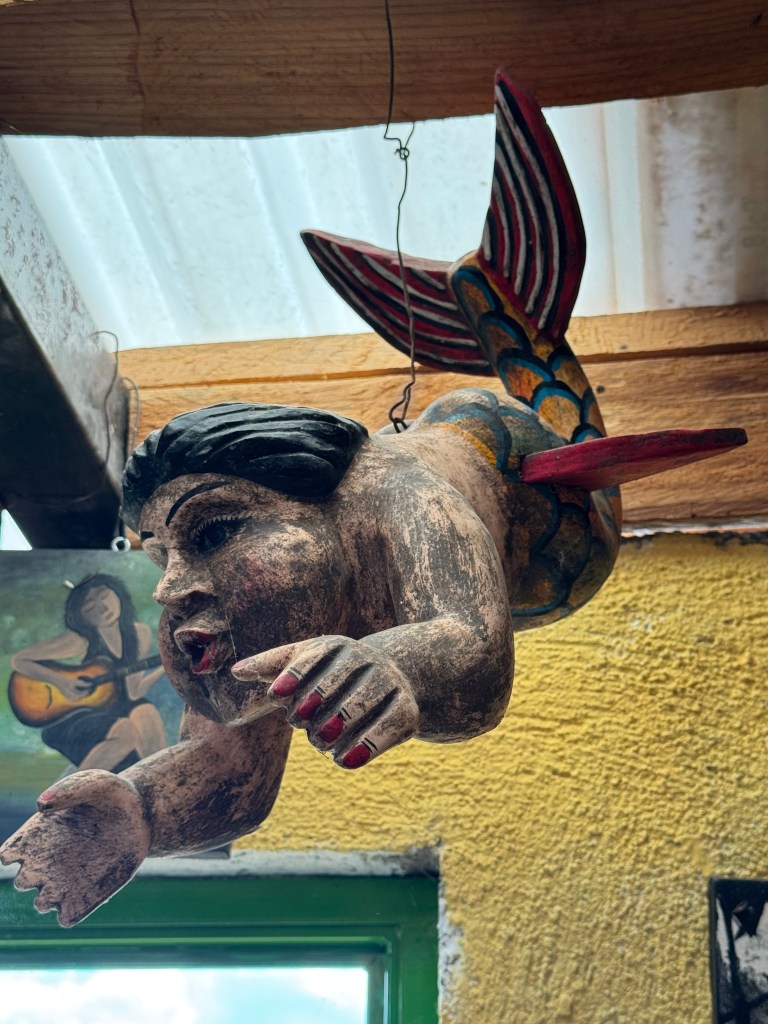
Back on the bus, we turned off on a side road (that was not made for a big bus, but our driver was amazing). Our destination was the home and studio of Manuel Reyes and Marisela Gomez. Their home is rather remote and the main hall and all rooms were galleries displaying their work. They prepared a delicious lunch for us, and many of us made purchases of their work, which includes paintings and ceramics and pottery.


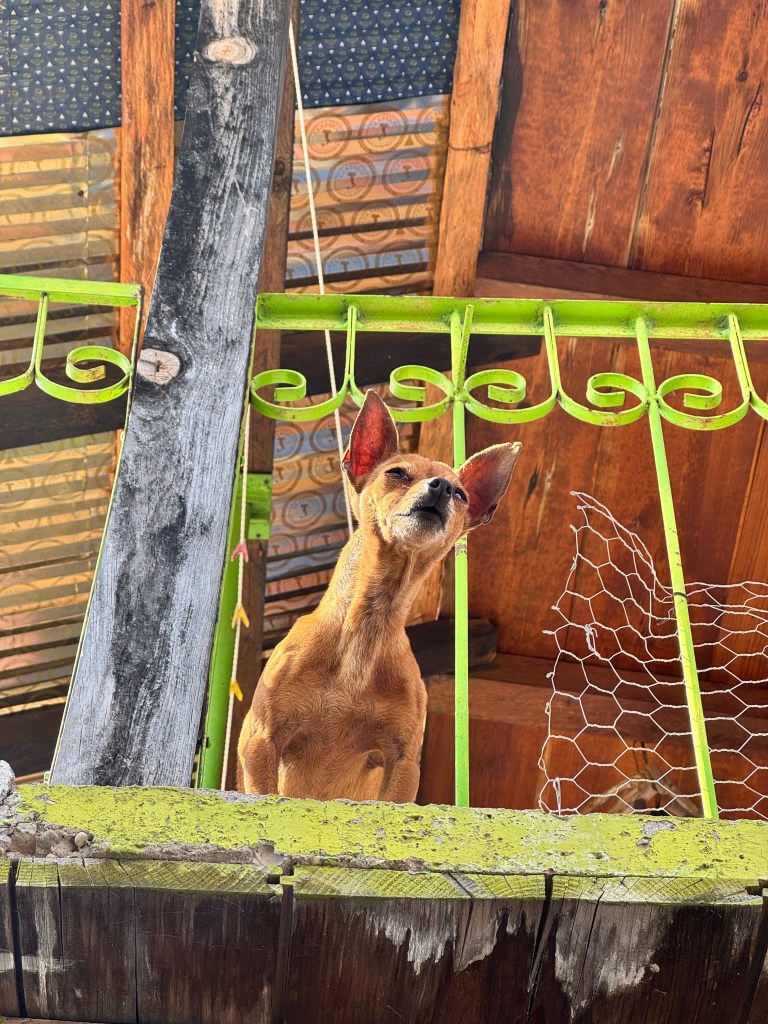
I’ve been looking for a chihuahua that I could photograph, and this couple had two! The black one even let me scratch her ears in the sun for a while. Just like my own mixed breed chihuahua, there is no limit to the amount of time she wanted her ears scratched. I believe the muse of photography was with me when the pup climbed the bright green staircase against the azul sky. The fawn pup never came down to see us, but she definitely took the whole group in from the balcony.


Back on the bus for last two hours into Oaxaca. We finished the day with an anthropology lecture from our professor, Colleen. Here are some things that jumped out to me, and that we were asked to consider:
- Oaxaca was more isolated and had sometimes prickly relationships with the national government;
- It is known for a large array of “indigenous,” or “native” folk arts such as wood carvings, weaving, baskets, and pottery but…
- Many of these are not “centuries old,” as they are often described, but relatively new art forms. The famed black pottery, for example, was originally a vessel for carrying water. When plastic arrived on the scene, some potters changed their form and even firing techniques so the more recent pottery is unlike the old forms;
- Similarly, weaving has also changed. There was no wool before the Spanish, so wool weaving might be old, but it’s not really ancient;
- The colorful wood carvings of mythical animals are also a 20th century art form, and not really based on anything Indigenous, and in fact originated from one particular artist though there are many more who practice the art now.
On the positive, the shopper can still be happy to buy something they like from Mexico. Better yet, the local artists have formed community art centers, and a sense of pride about the strong interest and economic enhancement that comes from selling folk art. In other words, it’s good to know about the advertising rhetoric, but if you like a piece of art and buy it, that’s all good too!
We are traveling with four current Vassar students, and it’s been fantastic! They each took a few minutes to tell us about the projects they did for the class they took together that culminates with this trip. I am so proud that my college is involving students with alums like this. There is a special fund that allows them to travel with us, so the trip is really just a part of their course work. I won’t call out their projects specifically, but they did an amazing job and were as interesting to listen to as our professors.
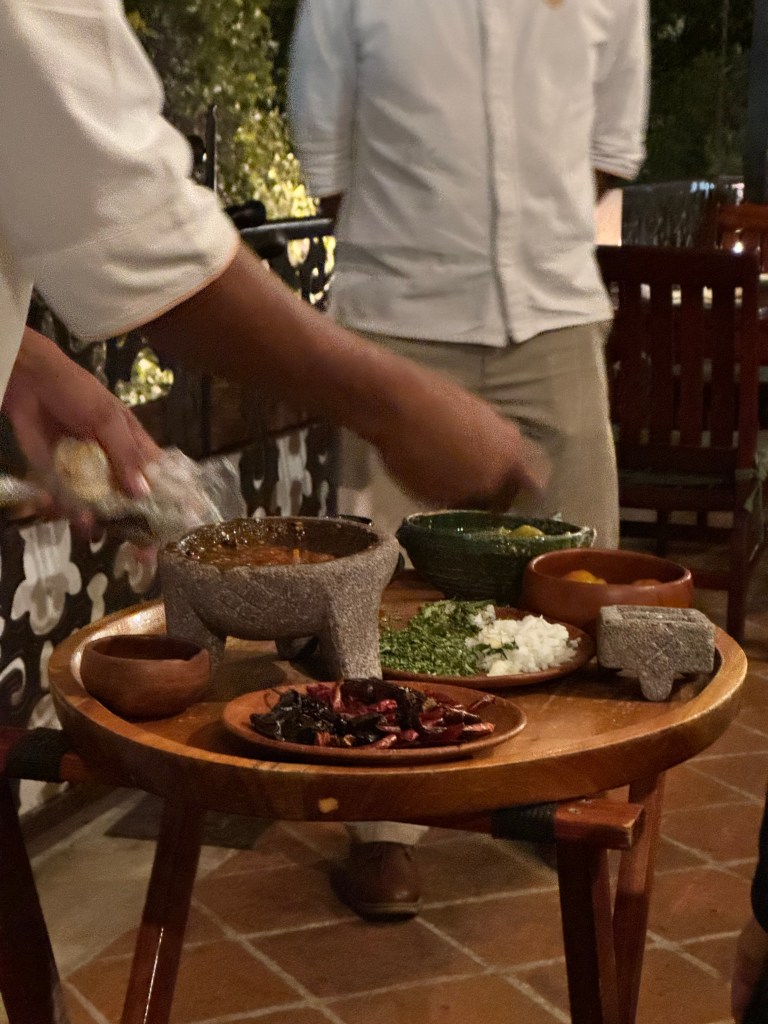
We had a great meal (again) on a terrace at Casa Oaxaca:


Leave a Reply